Why Some Trail Runners Never Roll an Ankle on the Same Terrain Others Do
Quick Answer: Runners who rarely roll an ankle on technical terrain tend to scan the trail 3-5 steps ahead rather than looking directly at their feet, and they land with a slightly shorter stride and more midfoot contact on uneven sections — both trainable habits, not just luck or ankle strength alone, meaning the difference between frequent rollers and rare rollers is often technique more than physical durability.
Ankle strength and stability training matter, but they’re only part of the picture — where your eyes and stride land matter just as much on technical terrain.

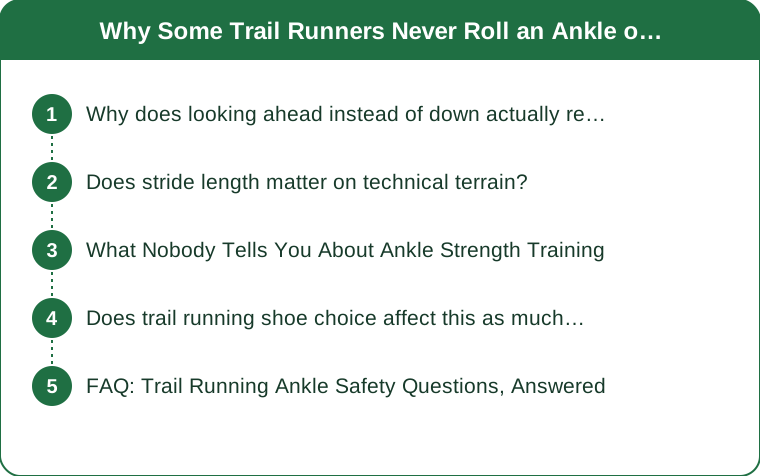
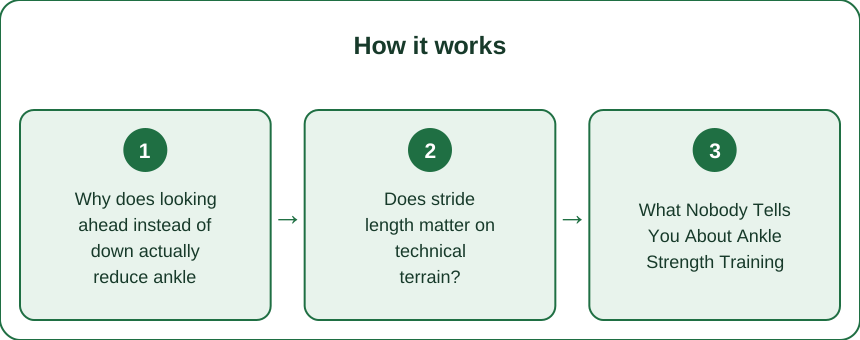
Why does looking ahead instead of down actually reduce ankle rolls?
Because scanning several steps ahead gives your brain time to plan foot placement before you arrive, rather than reacting to terrain your foot is already on top of. Looking directly down at your immediate footfall removes this planning window, forcing a reactive rather than anticipatory landing — which is when awkward, unstable foot angles are more likely.
Does stride length matter on technical terrain?
Yes — a shorter, quicker stride on uneven sections gives more frequent opportunities to adjust than a long, committed stride that’s harder to abort or modify mid-air once a foot placement turns out to be unstable. Many experienced trail runners deliberately shorten stride specifically through rocky or root-heavy sections, then lengthen again on clearer ground.

What Nobody Tells You About Ankle Strength Training
Ankle strength and proprioception training (single-leg balance work, wobble board exercises) genuinely reduces rolling severity when a roll does happen, even if it doesn’t eliminate the chance of a misstep entirely — the combination of trained ankles plus better scanning technique compounds, rather than either alone solving the whole problem.
Does trail running shoe choice affect this as much as technique?
It’s a supporting factor, not the main lever — a shoe with a lower stack height and wider platform generally offers more stability on technical terrain than a high, narrow stack, but shoe choice compensates for technique gaps somewhat rather than replacing the scanning and stride adjustments that matter most.
FAQ: Trail Running Ankle Safety Questions, Answered
How far ahead should you actually be looking while trail running?
Roughly 3-5 steps ahead on technical terrain, adjusting closer on very rocky sections and further out on clearer trail — the exact distance matters less than consistently looking ahead rather than straight down.
Do trekking poles help reduce ankle rolls?
Yes, meaningfully on very technical or steep terrain — poles add two additional points of ground contact for balance correction, which reduces reliance on ankle stability alone.
Is it worth slowing down significantly on technical sections to reduce roll risk?
Often yes — many runners find that a modest pace reduction on rocky or root-heavy terrain, in exchange for better foot placement accuracy, is a worthwhile trade that experienced technical trail runners make consistently rather than occasionally.
TL;DR:
- Scanning 3-5 steps ahead, not looking directly at your feet, gives your brain planning time that reduces rolls
- A shorter, quicker stride on technical terrain allows more mid-stride adjustment than a long committed stride
- Ankle strength training reduces roll severity even when a misstep happens
- Shoe stack height and platform width support but don’t replace good scanning and stride technique
Train your eyes and stride pattern alongside your ankles — the technique piece explains more of the difference than most runners assume.
Keep Reading
This article is for general informational and styling purposes only. Fit, sizing, and product availability may vary.