Why Trail Shoe Lugs Stop Gripping Before They Look Worn
Quick Answer: Trail shoes lose grip through two mechanisms that are invisible from a distance: lug edges rounding off and outsole rubber hardening with age. Both happen well before tread depth looks low. A shoe with 4mm of visible lug but rounded edges and two-year-old rubber will slip on wet rock where a fresh one holds. Check the edges, not the depth, and note the manufacture date on shoes bought on sale.
The shoes look fine. Plenty of tread left. And you have started sliding on descents you used to run without thinking.
You are not getting worse. The rubber is.

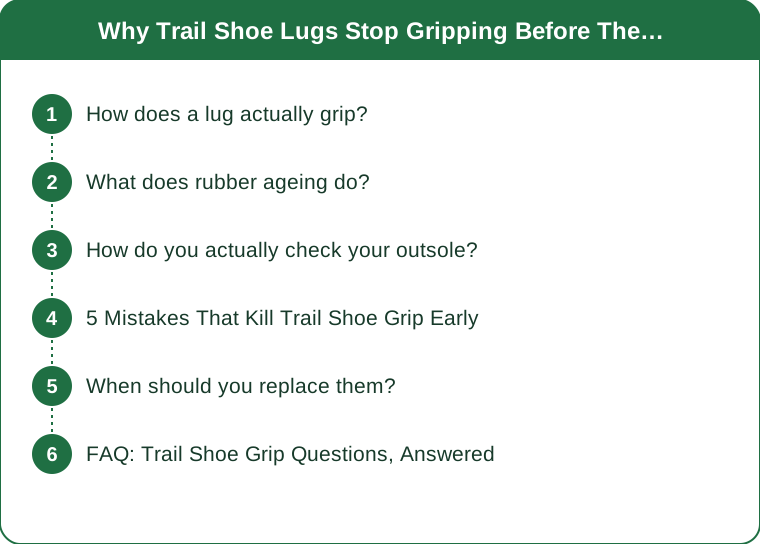
How does a lug actually grip?
Two ways, and they fail independently.
Mechanical interlock. On soft ground — mud, loose dirt, grass — the lug penetrates and pushes against the material. This depends on lug depth and spacing, and it is what most people picture when they think about tread.
Friction at the edge. On hard ground — wet rock, roots, packed trail — the lug cannot penetrate anything. Grip comes from the rubber deforming against the surface, and it is concentrated at the sharp edges of the lug, where pressure per square millimetre is highest.
That second mechanism is the one that fails first, and it is the one that matters most on the surfaces where slipping is dangerous. A rounded lug on wet rock has no high-pressure edge to bite with. It is a smooth surface pressed against a smooth surface.
So tread depth measures the mechanism you are less likely to need, and tells you nothing about the one you are.
What does rubber ageing do?
Outsole rubber hardens over time as plasticisers migrate out and the polymer oxidises. This happens whether or not the shoe is used — a pair sitting in a box ages nearly as fast as a pair being run in.
Harder rubber conforms less to surface irregularities, so it makes less real contact area and grips worse. The effect is most pronounced on wet rock, which is precisely where trail runners rely on soft, sticky compounds.
This has a practical consequence people rarely consider: a discounted shoe may be discounted because it has been in a warehouse for two years. The tread is untouched and the rubber is already partway through its useful life.
Most shoes carry a manufacture date inside the tongue or on the box label, usually as a month-year code. It is worth looking at when buying older stock, particularly for a shoe you are buying specifically for its grip.
How do you actually check your outsole?
Four checks, thirty seconds, in daylight:
1. Run a fingernail along a lug edge. A fresh lug has a defined corner that catches your nail. A worn one is rounded and your nail slides over it. Compare the forefoot outer edge — which wears first — against a lug in the arch, which barely wears at all. That comparison is the clearest signal available.
2. Press the rubber with your thumbnail. Fresh soft-compound outsole gives slightly. Aged rubber feels hard and glassy.
3. Look for shine. A polished, reflective look on the contact surfaces means the rubber has glazed. Glazed rubber on wet rock is effectively skating.
4. Check for lug tearing at the base. Lugs that flex and tear where they meet the midsole have lost their stiffness, so they fold under load instead of biting.
If two or more of those show up, grip is compromised regardless of what the tread depth suggests.

5 Mistakes That Kill Trail Shoe Grip Early
1. Running them on road. Tarmac is the fastest way to round off lug edges — a few kilometres of road approach each run does more edge damage than the whole trail section. If your route starts with pavement, consider a second pair for the approach or accept a much shorter grip life.
2. Drying them near heat. A radiator, a car dashboard, or direct sun accelerates rubber hardening dramatically. Newspaper stuffing at room temperature, away from any heat source.
3. Leaving mud on them. Dried mud packed between lugs prevents penetration on the next run and holds moisture against the rubber. Rinse after muddy runs, which takes two minutes.
4. Storing them in a hot car. The worst environment available. A car boot in summer regularly exceeds 50°C and ages rubber fast.
5. Judging replacement by midsole feel. People replace shoes when the cushioning goes flat. On trail shoes the outsole often gives up first, and the shoe still feels fine underfoot while it has stopped gripping. Cushioning and grip are separate clocks.
When should you replace them?
There is no single mileage number, because the answer depends on surface and use. Working guidance:
- Grip-critical use — technical, wet, rocky terrain: replace when the fingernail test fails on the forefoot lugs, often at 300 to 500km if you run mixed surfaces.
- Soft ground use — mud, grass, forest trail: depth still matters here, so you can run further, often 600 to 800km, until lugs are visibly reduced.
- Age limit regardless of mileage: if the shoe is more than about three years old from manufacture, treat the grip as compromised even if it looks new.
A practical approach that costs nothing: keep the old pair for dry, non-technical runs and use the new pair when conditions matter. You get full value from the tread depth without relying on edges that are gone.
Autumn is the season to check, because wet leaves over rock is the most grip-dependent surface most trail runners meet all year, and it arrives suddenly.

FAQ: Trail Shoe Grip Questions, Answered
Are deeper lugs always better?
No. Deep lugs on hard ground reduce contact area and feel unstable, and they wear faster on any firm surface. Match lug depth to terrain — 3 to 4mm for mixed and hard-packed, 6mm and up for genuinely soft ground. Choosing the deepest available is a common mistake.
Does the rubber compound matter more than the pattern?
On wet rock, yes, substantially. Sticky compounds grip wet rock far better than harder ones regardless of pattern, and they wear faster in exchange. On mud, pattern and depth dominate and compound matters much less. Decide which surface actually defines your running.
Can I do anything to restore grip on an old pair?
Not meaningfully. Sanding the outsole to expose fresh rubber is sometimes suggested and it removes what lug height remains while doing nothing about hardening through the whole layer. Cleaning helps if they are glazed with dried mud; nothing helps if the rubber itself has aged.
TL;DR:
- Grip on hard and wet surfaces comes from sharp lug edges, not tread depth — and edges round off first.
- Outsole rubber hardens with age whether used or not, so heavily discounted old stock may already be compromised.
- Test by running a fingernail along a forefoot lug edge and comparing it to an unworn arch lug.
- Road running, heat drying, and hot car storage are the fastest ways to destroy grip.
Do the fingernail test before your next wet run. It takes ten seconds and it is far more honest than looking at the tread.
Keep Reading
This article is for general informational and styling purposes only. Fit, sizing, and product availability may vary.