Why Your Running Cadence Should Actually Change Going Uphill
Quick Answer: Cadence naturally drops on steep uphill trail sections as stride length shortens and effort per step increases — fighting to maintain flat-ground cadence uphill wastes energy rather than improving performance.
Runners who obsess over hitting a specific cadence number on flat road running often bring that same target to steep trail climbs, where it actively works against efficient movement.

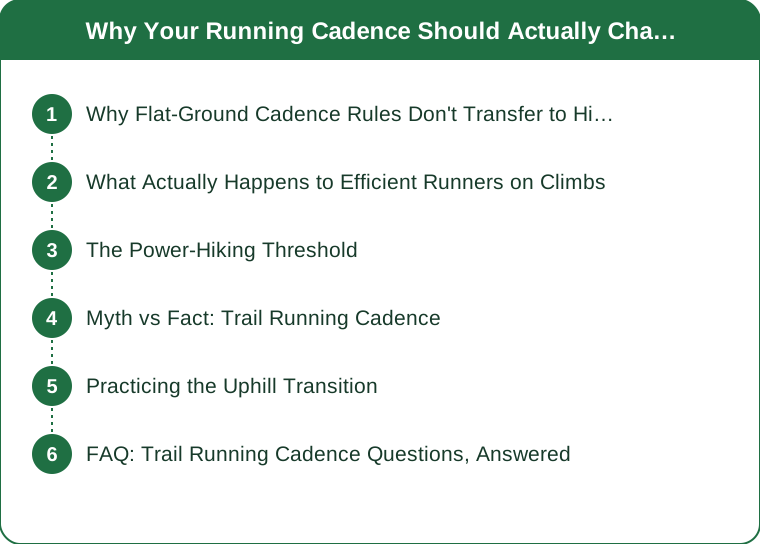
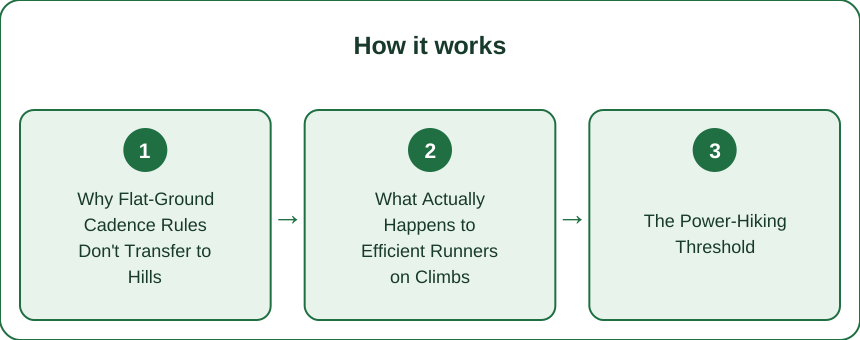
Why Flat-Ground Cadence Rules Don’t Transfer to Hills
Cadence targets (often cited around 170-180 steps per minute) are derived from flat-ground running biomechanics, where stride length and ground contact time follow a fairly consistent pattern. On a steep uphill, stride length naturally shortens as the incline increases, and trying to maintain the same steps-per-minute rate while also maintaining a normal stride length is mechanically inefficient — something has to give.
What Actually Happens to Efficient Runners on Climbs
Efficient trail runners naturally shift toward shorter, quicker steps on moderate climbs, and often transition to a fast hiking power-walk on very steep sections — a pace and gait shift experienced trail runners use deliberately rather than avoid. Research on elite trail athletes consistently shows this gait transition happens at a predictable grade threshold, often somewhere around 15-20% incline depending on fitness.
The Power-Hiking Threshold
For most runners, once incline exceeds roughly 15-20%, hiking briskly with a strong arm drive burns less energy and maintains a similar or better pace than trying to run the same section. Elite trail and mountain runners incorporate this transition explicitly into race strategy rather than treating hiking as a failure to keep running.

Myth vs Fact: Trail Running Cadence
Myth: A good trail runner never needs to hike, even on steep climbs. Fact: strategic hiking on steep grades is standard practice even among elite ultra-runners, since it conserves energy for later in longer efforts. Myth: Cadence should stay constant across all terrain for good running economy. Fact: cadence naturally and appropriately varies with grade, footing, and technical difficulty — a single fixed target ignores how terrain-adaptive efficient trail running actually is.
Practicing the Uphill Transition
On training runs, practice consciously shortening stride and quickening steps as grade increases, rather than waiting until you’re gasping to make the change. Identifying your personal power-hiking threshold — the grade at which hiking becomes faster or equally fast as running for you specifically — through a few test climbs helps remove the guesswork on race day or long training runs.
FAQ: Trail Running Cadence Questions, Answered
Should I use a cadence-tracking watch for trail running?
Cadence data can be useful for spotting general trends, but treating flat-ground cadence targets as a strict goal on variable trail terrain often does more harm than good.
Does downhill running need a cadence adjustment too?
Yes — downhill sections often benefit from a quicker, lighter cadence with shorter stride to reduce impact force and improve control, the opposite adjustment from steep uphills.
How do I know if I should be running or hiking a specific climb?
As a rough guide, if your running pace on a climb isn’t meaningfully faster than a brisk hike with arm drive, hiking is usually the more energy-efficient choice for that section.
TL;DR:
- Cadence naturally shortens with stride length on steep uphill terrain
- Power-hiking is standard practice above roughly 15-20% incline, even for elites
- Fighting to maintain flat-ground cadence uphill wastes energy
- Practice the run-to-hike transition deliberately rather than waiting until exhausted
Efficient trail running isn’t about a fixed cadence number — it’s about matching gait and pace strategy to the actual grade in front of you.
Keep Reading
This article is for general informational and styling purposes only. Fit, sizing, and product availability may vary.