Running on Leaves: Why Autumn Trails Hide Everything
Quick Answer: Leaf cover removes your ability to read terrain, and wet leaves on rock or hardpack are genuinely slippery — comparable to running on ice in the worst cases. The adaptations: shorten your stride and raise your cadence, look further ahead rather than at your feet, slow the descents deliberately, and treat a leaf-covered trail as an unknown trail even if you have run it a hundred times.
You know this trail. You have run it all summer, you know where the rocks are, you know the one root that catches people.
Then October arrives and the whole thing is under four inches of leaves. Your visual model of the trail is gone, and it is replaced by a surface that looks uniform and is not — which is exactly the condition that produces rolled ankles. The third section covers why running it from memory is worse than running it as a stranger.

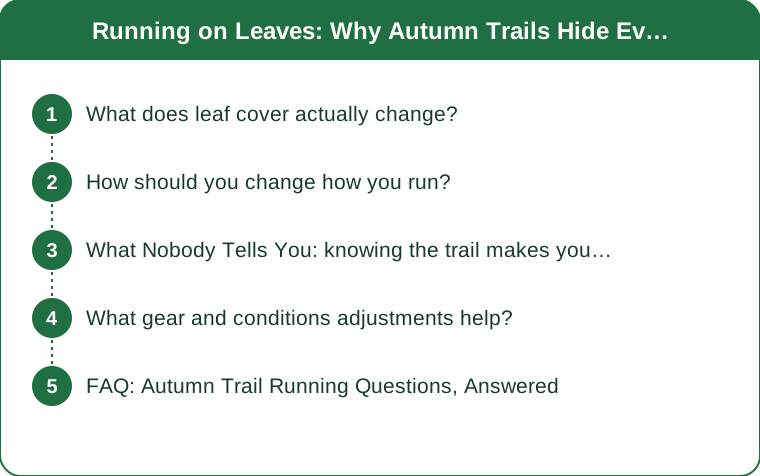
What does leaf cover actually change?
Three separate problems that arrive together.
You lose terrain reading. Trail running is fundamentally a visual task — you scan ahead, identify features, and plan foot placement several steps in advance, largely without conscious thought. Leaf cover removes the input that whole system depends on. A flat blanket of leaves looks like a flat surface, and underneath it the trail has the same rocks, roots, and holes it always did.
Wet leaves are genuinely slippery. Dry leaves are mostly a visual problem. Wet leaves are a traction problem, and a serious one. A layer of wet leaves on rock or packed dirt provides very little friction, and a leaf layer can shear across the surface underneath — you plant your foot, the leaves slide, and your foot goes with them. On a sloped rock this is one of the more treacherous surfaces you will encounter on a trail.
Depth is unreadable. A leaf-filled hole looks exactly like leaf-covered flat ground. Stepping into an unseen hole at running speed with your ankle unprepared is the classic mechanism for a bad ankle roll, and it is much worse than rolling on a rock you saw, because you had no chance to pre-tension anything.
There is a secondary effect worth knowing: leaves obscure the trail itself. On faint or less-travelled trails, the tread disappears entirely under leaf cover, and route-finding becomes genuinely harder. Combined with shorter days, this is how a familiar run turns into a longer one.
How should you change how you run?
Technique adjustments, all of which trade speed for control.
Shorten your stride and raise your cadence. This is the master adjustment and it addresses several problems at once. A shorter stride means your foot lands closer to under your center of mass, so if the surface moves or gives way you have far more chance to recover. It also reduces impact force at each landing and lets you change direction faster. Think quick, light, small steps.
Land more softly, with a flatter foot. A hard heel strike on wet leaves is where slips happen — a heel plant is a shearing force on a surface with almost no shear resistance. A more midfoot landing puts more of the shoe in contact and reduces the shearing.
Look further ahead, not down. Counterintuitive, since you cannot see the ground anyway. But looking 10 to 15 feet ahead lets you read the shape of the terrain — the rise and fall, where rocks are likely, where the trail bends — even when the surface details are hidden. Staring at your feet gives you no time to react to anything.
Keep your knees softer. A slightly more flexed knee absorbs surprises. Running with straight, stiff legs on unpredictable terrain transmits everything straight to your joints and leaves you nothing to react with.
Widen your stance slightly for lateral stability, and be ready to use your arms for balance. Running with hands free rather than clamped to a bottle is worth more in these conditions.
Slow down on the descents, decisively. This is where the consequences concentrate, and it is where most people do not adjust. A descent on wet leaves warrants a genuinely conservative pace — the speed you would use in the dark.

What Nobody Tells You: knowing the trail makes you less safe
The counterintuitive finding, and it explains a lot of autumn injuries on home trails.
Familiarity produces automaticity. After you have run a trail enough times, your foot placement becomes partly predictive rather than purely reactive — you are running from an internal model of the trail as much as from what you are currently seeing. This is efficient and it is a real skill.
Leaf cover invalidates the model without removing your confidence in it. The rocks are still there, but leaves change what your foot actually contacts, they redistribute where water sits, and they fill in the small depressions your feet had learned to avoid. Meanwhile your brain is still running the summer map.
The result: you run your familiar trail at your familiar pace with your familiar confidence, on a surface that has changed underneath you. A stranger on the same trail would be moving more cautiously and reading the ground more carefully, and would be safer for it.
The specific fix is a mental one: treat a leaf-covered familiar trail as an unfamiliar trail. Consciously downgrade your assumptions. This sounds soft and it is the most useful thing in this article, because it changes the pace you choose at the top of the descent, which is where the injuries happen.
Two practical supports for that:
Run a leaf-covered section slower the first time each season, deliberately, to recalibrate. Your model needs updating and one cautious run does most of it.
Be more careful on trails you know than on ones you do not. This inverts the usual instinct, and it matches where the injuries actually happen.
The related seasonal factor: autumn is when ankle injuries cluster in trail running, and it is a combination of leaf cover, wet conditions, and lower light — all three degrading terrain reading at once. If you are going to do prehab work for ankles, this is the season it pays off.
What gear and conditions adjustments help?
Some are equipment, some are timing.
Shoes with aggressive, well-spaced lugs. Deep lugs bite through the leaf layer to the surface underneath. Well-spaced lugs shed debris rather than packing with wet leaves and mud, which turns your outsole into a slick. Worn-out lugs are a real hazard in these conditions — check yours at the start of the season, because tread that was adequate on dry summer trail is not adequate now.
Consider a shoe with a rock plate if your trails are rocky, since you will be landing on things you did not see.
Gaiters are genuinely useful. They keep leaves and debris out of your shoes, which is more than a comfort issue — a leaf or twig under your foot is a small unstable surface inside your shoe.
Ankle strength work is the highest-value training adaptation. Single-leg balance work, controlled ankle mobility, and calf and peroneal strengthening improve both your resistance to rolling and your ability to recover from a roll that has started. This is genuinely protective and it takes ten minutes a couple of times a week.
Poles, on steep technical descents. More common in ultra and mountain running, and worth considering for exactly this season.
Time your runs for light. Leaf cover plus low light is a compounding problem. A run that finishes at dusk on leaf-covered trail is meaningfully riskier than the same run at noon, and autumn light disappears earlier under canopy than the sunset time suggests. Carry a headlamp once your runs get near the edge of daylight.
Read the weather with leaves in mind. The day after rain is worse than during rain, because the leaves are saturated and matted. A hard frost changes things again — frozen leaves over frozen ground can be extremely slick.
And know when to pick roads. Some conditions — heavy fresh leaf fall on top of rain, on a technical descent-heavy trail — are just not worth it. Choosing the road that day is a legitimate decision rather than a failure of nerve.
FAQ: Autumn Trail Running Questions, Answered
Are dry leaves actually dangerous or just annoying?
Mostly they are a visibility problem rather than a traction problem — dry leaves provide reasonable grip. The hazard is that they hide the terrain, so the risk is a rolled ankle rather than a slip. Wet leaves add the traction problem on top.
Should I stop running technical trails in autumn?
No, but adjust pace and expectations, especially on descents. Autumn is some of the best running of the year and the fitness benefits of technical terrain are real. Treat it as an unfamiliar trail and run it at that pace.
How do I strengthen my ankles for this?
Single-leg balance work, including on an unstable surface, progressed to eyes-closed. Calf raises through full range, and specific work for the muscles on the outside of the lower leg. Consistency matters more than complexity. If you have a history of ankle sprains, a proper rehab progression from a professional is worth the visit — this is general information, not medical advice.
Do I need different shoes just for autumn?
Not necessarily different shoes, but check the tread on the ones you have. Lug depth wears down gradually and you may not notice until conditions demand it. If your usual trail shoes have a shallow tread, a more aggressive pair is a reasonable seasonal addition.
TL;DR:
- Leaf cover removes terrain reading and hides holes, rocks, and roots completely.
- Wet leaves on rock or hardpack offer very little traction and can shear underfoot.
- Shorten your stride, raise your cadence, soften your knees, and look 10 to 15 feet ahead.
- Familiar trails are more dangerous under leaves, because your internal map is now wrong.
- Check lug depth, do ankle strength work, and slow the descents decisively.
There is a real argument that autumn is the best trail running of the year — the air is right, the light is extraordinary, and the trails have emptied out. The whole season costs you one adjustment: accepting that the trail under your feet is not the one in your head, and running the descents like you have never seen them before. Do that, and October is a gift. Skip it, and it is the month you spend on the couch with a taped ankle wondering how it happened on the trail you know best.
Keep Reading
This article is for general informational and styling purposes only. Fit, sizing, and product availability may vary.