Why Your Stride Falls Apart Running Trails at Night — and How to Fix It
Quick Answer: Running trails at night is harder because a headlamp mounted at eye level throws light nearly parallel to your line of sight, which eliminates the shadows your brain uses to judge depth and surface texture. Roots and rocks flatten into a uniform image. The fixes are a second light mounted low at the waist or chest to restore shadow, a higher cadence with shorter steps to reduce commitment per foot strike, sufficient lumens with a wide flood pattern rather than a narrow spot, and accepting a slower pace as correct rather than as failure.
You run this trail three times a week. At night, on the same trail, you’re tripping on things you’ve never noticed and running two minutes per mile slower. Your fitness didn’t change in the last hour.

Why does night running feel so much harder on trails?
Because you lose the specific visual information your feet depend on.
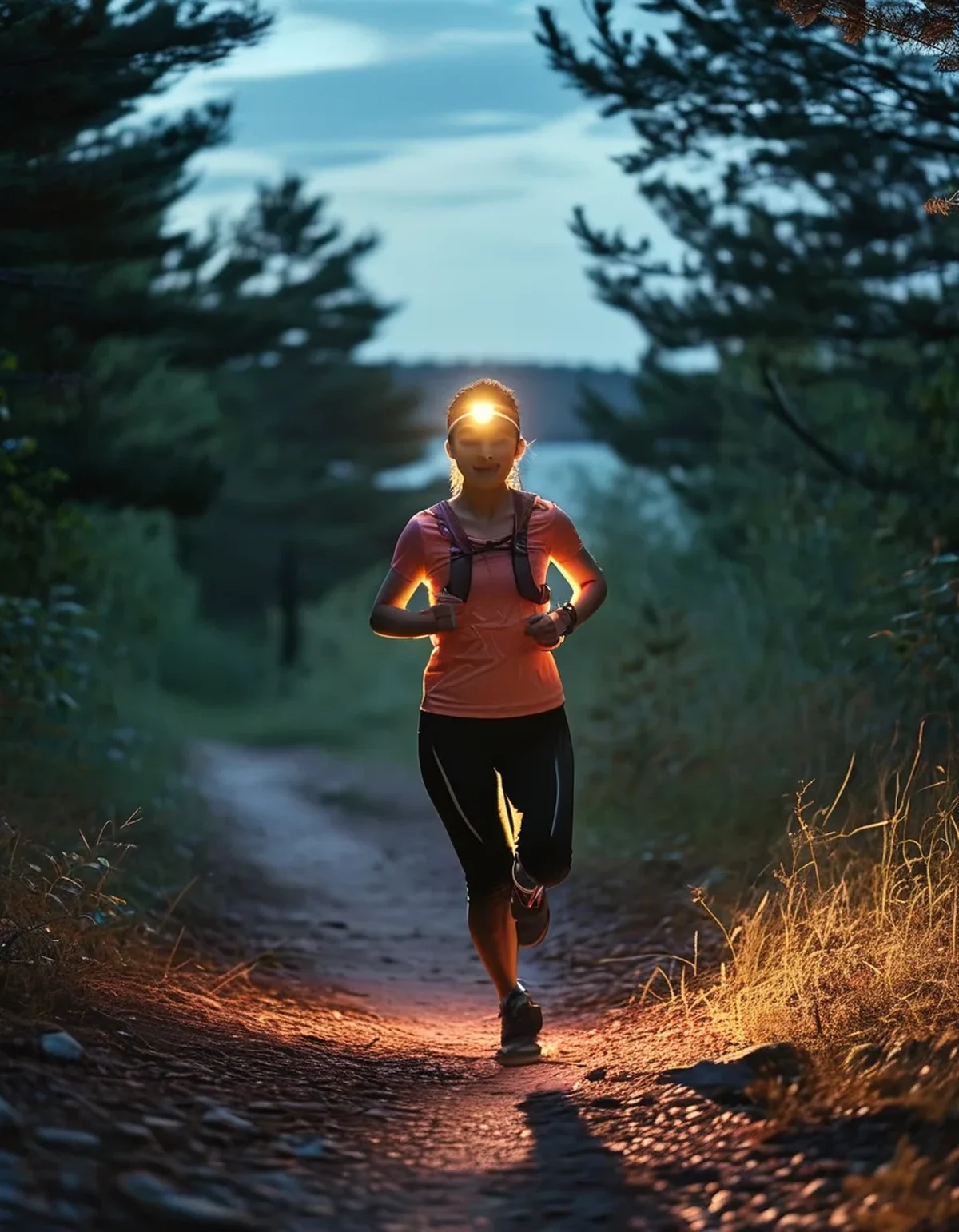
Depth perception on trails comes largely from shadows. In daylight, the sun is above and to the side, so every root, rock, and dip casts a shadow. Those shadows tell your brain about height and depth before your foot arrives. A headlamp sits at your eyes and points where you look, so the light travels almost parallel to your line of sight — and objects lit from directly behind the viewer cast almost no visible shadow. The trail becomes a flat, evenly-lit image.
The result: a shallow puddle and a deep hole look identical. A flat rock and a protruding one look identical. Your foot-placement system, which relies on rapid unconscious judgments about surface height, is running on degraded input.
Peripheral vision is also gone. In daylight, a wide field of view lets you plan several steps ahead and register terrain at the edges. A headlamp beam is a cone, and everything outside it is black. You’re effectively running through a tube, which forces you to look at your immediate footing rather than reading the trail ahead.
And the beam moves with your head. Look down to check footing and the light leaves the trail ahead. Look ahead and you can’t see your feet. This head-position conflict is exhausting in a way that doesn’t happen in daylight.
Add the physiological piece: reaction time to visual stimuli is slower in low light, and the stress of reduced information raises perceived effort. The pace feels harder at a lower heart rate, which is disorienting for people used to running by feel.
What lighting setup actually solves the shadow problem?
Two lights at different heights, which is the fix most runners discover years later than they should.
A waist or chest light is the key addition. Mounted at your waist, the light comes from a low angle relative to the ground, which means objects on the trail cast visible shadows toward you. Depth returns immediately. Most runners describe the first night run with a waist light as a step change rather than an improvement.
Keep the headlamp too, for looking ahead and to the side. The headlamp handles trail-finding, turns, and looking where you’re going; the waist light handles footing. The two-light setup is standard among experienced night trail runners and ultra racers, and it’s the single most effective change available.
On brightness: for technical trails, 300 to 500 lumens from the head unit is a reasonable working range, with more for fast descending. Beam pattern matters more than raw lumens. A wide flood restores some peripheral awareness; a narrow spot creates tunnel vision even at high output. Lights with both a flood and a spot, blended, are ideal.
Battery strategy: cold reduces battery output significantly. Carry a spare or a battery pack, and know your light’s runtime at the brightness you actually use — not the manufacturer’s number at the lowest setting.
Mounting stability: a headlamp that bounces creates a moving light field that’s genuinely nauseating on descents. A top strap or a rear battery pack for balance helps considerably.
Red light for stopping: useful for map checks and aid stations without destroying your dark adaptation, and it doesn’t blind training partners.
What not to do: run with a phone flashlight, which is too dim, too narrow, occupies a hand, and drains the device you might need.
5 Technique Changes That Make Night Trails Safer
1. Shorten your stride and raise your cadence. A shorter step means less committed weight on each landing and more capacity to adjust mid-stride. Aim for 5 to 10 percent higher cadence than your daylight trail pace at the same effort. This single change absorbs most of the increased trip risk.
2. Land more under your center of mass. Overstriding is punished harshly at night, because a heel landing far in front of you has no ability to react to an unexpected surface. Landing closer to underneath gives the ankle and foot a chance to adapt.
3. Lift your feet more. Most night trips are catches on low obstacles that would clear in daylight because you’d have seen them. Deliberately lifting the toes and knees slightly higher costs a small amount of energy and eliminates a large fraction of the trips.
4. Look further ahead than feels natural. The instinct is to stare at your feet, which is exactly wrong — by the time your foot is there, the decision is made. Scan 10 to 15 feet ahead and trust your proprioception for the immediate step. The waist light is what makes this possible, because it lights the ground without requiring you to look down.
5. Slow the descents disproportionately. Descending is where the depth-perception loss costs the most, because speed reduces reaction time exactly when information is worst. Experienced night runners often descend at a fraction of their daylight pace and make it up elsewhere.
The one that surprises people: running behind someone else at night is harder, not easier. Their body blocks your light, your light casts their shadow onto the trail creating false obstacles, and you can’t see their foot placement. Run beside them where the trail allows, or leave a proper gap.
How do you build up to it safely?
Progressively, on terrain you already know, which is how most people skip straight past the accidents.
Start on a familiar trail. Knowing where the technical sections are removes half the cognitive load and lets you focus on the new skill. Your regular loop, at night, is the right first session.
Start at dusk, not full dark. Running into the transition lets your eyes and your confidence adjust gradually, and you get to see the trail before it disappears.
Keep the first sessions short. 30 to 40 minutes. The mental load is high and fatigue accumulates faster than the physical effort suggests.
Progress in this order:
- Familiar trail, dusk, easy pace
- Familiar trail, full dark, easy pace
- Familiar trail, full dark, normal effort
- New trail, full dark, easy pace and conservative descents
Run with someone for the first several sessions. Beyond safety, having a second light source and a second set of eyes on the trail makes the learning faster.
Practical safety items for night trail running:
- Phone, charged, and someone who knows your route and expected return time. Non-negotiable.
- A spare light or battery. A failed headlamp on a technical trail in full dark is a genuinely serious situation.
- Reflective elements, particularly if any part of the route crosses or follows roads.
- A layer, because temperatures drop after dark and a twisted ankle turns a warm run into a cold wait.
- Awareness of wildlife activity, which is higher at dawn and dusk in most regions.
Expect the pace to be slower and let it be. Running the same route two minutes per mile slower at night is normal, not a fitness problem. Judging night runs by daylight pace is the fastest route to an injury.
What does night running do for your daytime trail skills?
More than most runners expect, and it’s a legitimate training tool rather than just a logistical necessity.
Proprioception improves. With degraded visual input, your ankles and feet do more of the stabilizing work, and that system adapts. Many runners report better technical footing in daylight after a block of night running.
Cadence habits stick. The shorter, quicker stride that night running forces tends to carry over, and it’s a stride pattern with a better injury profile on technical ground generally.
Descending technique gets more honest. You can’t rely on charging blindly downhill, so you learn to descend with control, quick feet, and better line choice. That’s a skill that transfers directly.
Mental resilience develops. Managing the discomfort of reduced information, running alone in the dark, and staying calm when the trail gets confusing is a specific kind of tolerance. Anyone considering an ultra will run in the dark at some point, and doing it for the first time at 2am during a race is a poor plan.
Practical schedule benefits are real too. Through autumn and winter, night running is often the only way to get trail time on weekdays. Treating it as a skill to develop rather than a compromise changes the whole experience.
One caution: night running is more demanding on the nervous system than the pace suggests. Two night sessions a week is plenty alongside other training, and the recovery cost of the concentration is real. Don’t schedule your hardest workout in the dark on technical ground.
This is general information, not medical advice. Build up gradually and prioritize familiar terrain.
FAQ: Night Trail Running Questions, Answered
How many lumens do I actually need?
For most technical trail running, 300 to 500 lumens from a head-mounted light is a workable range, with a waist light adding 200 or more. Beam pattern matters more than the number — a wide flood at 300 lumens is more useful than a narrow spot at 800, which creates tunnel vision.
Is a waist light really necessary or is that just gear marketing?
It’s the single most effective change for depth perception, and the reason is geometric rather than commercial: light from a low angle creates shadows that light from eye level cannot. Most runners who try the two-light setup don’t go back.
Should I run night trails alone?
It’s done routinely, but the risk profile is genuinely different — a fall that’s inconvenient in daylight can be serious in the dark and cold. If you go alone, stay on familiar trails, tell someone your route and return time, carry a spare light, and consider a satellite communicator for areas without cell coverage.
TL;DR:
- A headlamp at eye level removes shadows, and shadows are how you judge trail depth.
- Add a waist or chest light — the low angle restores shadow and it’s the biggest single improvement available.
- Shorten the stride, raise cadence, lift the feet more, and look 10 to 15 feet ahead rather than at your shoes.
- Descend far more conservatively, and stop judging night runs by your daylight pace.
It’s not a fitness problem. You’re running on two-thirds of the information.
Keep Reading
This article is for general informational and styling purposes only. Fit, sizing, and product availability may vary.