Why Trail Runners Should Walk the Steep Parts on Purpose
Quick Answer: Above roughly 15 to 20% gradient, walking with good technique is close to the same speed as running for most people and costs substantially less energy — so running it buys you almost nothing and takes fitness you need later. Elite mountain runners walk steep climbs deliberately. The skill is knowing your crossover gradient and having a practised, powerful hiking gear rather than a demoralised shuffle.
You run every climb because walking feels like quitting, and then you have nothing left for the descent where the time actually is.

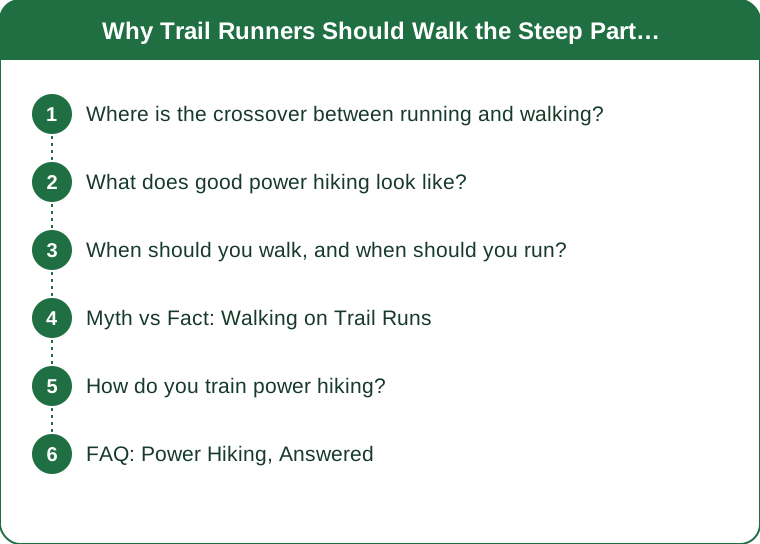
Where is the crossover between running and walking?
It depends on the gradient, your fitness, and the surface — but the principle is well established.
As a slope steepens, running becomes progressively less economical relative to walking. On flat ground running is far faster for the same effort. On very steep ground the two speeds converge, because running uphill requires substantial vertical work with each stride and the horizontal gain shrinks to almost nothing.
Research on uphill locomotion consistently finds a crossover — a gradient above which walking costs less energy for the same speed. For most runners it sits somewhere around 15 to 20%, and it varies with fitness, leg length, and how practised your hiking is.
Above that crossover, running a climb buys you seconds and costs you a great deal. Heart rate spikes, legs accumulate fatigue, and you arrive at the top with less than you would have had — for a difference measured in a handful of seconds per climb.
Below the crossover, running is clearly better, and this matters too: habitually walking every incline is the opposite error and it is common in newer trail runners once they discover power hiking.
The practical way to find your own crossover: on a long steady climb, run 30 seconds and hike 30 seconds at a hard effort and compare your progress. If hiking keeps pace with running, you are above your crossover and should hike it. Do this on a few different gradients and you will develop a reliable feel within a couple of sessions.
And know that it moves with fatigue. Your crossover gradient drops as you tire, which means late in a long run you should be walking climbs you ran at the start. That is correct pacing, not decline.
What does good power hiking look like?
It is a specific technique, not just walking slowly, and most runners have never practised it.
Posture: lean forward from the ankles, not the waist. A forward lean from the hips collapses your chest and restricts breathing. Leaning from the ankles keeps the torso long and puts your centre of mass over the driving leg.
Hands on quads, pushing down with each step. This is the single most effective technique cue — pressing on the front of your thigh as you extend the leg adds real force from your arms and shoulders. It looks like struggling and it is what fast people do.
Short, quick steps rather than long strides. A long stride uphill puts the leading leg in a mechanically poor position with the knee well flexed, which demands a great deal from the quad. Shorter steps keep you nearer to a strong position and let you maintain cadence.
Full hip extension at the back. Push all the way through — the glute is the strongest muscle available and a short, choppy hike never engages it.
Drive with the arms. Whether on your quads or swinging, arms contribute meaningfully to uphill propulsion. With poles, they contribute more.
And keep the effort honest. Power hiking is not a rest — done properly it should sit at roughly the same effort as your climbing run pace, just delivered more economically. The mistake newer runners make is treating a hike as recovery, which is where the time genuinely goes.
A useful check: cadence. Count your steps for 15 seconds. A good power hike is brisk — noticeably faster turnover than a walk in the park. If your feet are slow, you are strolling.
When should you walk, and when should you run?
Five situations that call for hiking, and the discipline to run everything else.
Hike when:
- The gradient is above your crossover — typically steep enough that a running stride becomes short and choppy anyway.
- The surface is technical. Loose rock, roots, mud, and steps demand foot placement, and running them costs energy in stabilising for no speed gain.
- Your heart rate has spiked above your sustainable range. On a long run, a climb that pushes you well past your aerobic ceiling is borrowing from the rest of the day.
- You need to eat or drink. Hiking is far easier to eat during than running, and on any run over about 90 minutes fuelling is a real constraint. Use climbs as your feeding windows deliberately.
- It is late in a long effort and your crossover has dropped with fatigue.
Run when:
- The gradient is moderate — anything you can maintain a normal stride on.
- The surface is runnable and you are not fighting for footing.
- The climb is short. A 20-second rise is usually not worth changing gear for, since the transitions cost something too.
- You are fresh and the effort is sustainable.
And practise the transitions. Switching between running and hiking has a cost, and doing it smoothly is a skill. Decide before the gradient changes rather than mid-stride, and make the switch decisively rather than degrading gradually into a shuffle — the drift from running into an unplanned trudge is where most people lose time without noticing.

Myth vs Fact: Walking on Trail Runs
Myth: Walking means you are not fit enough. Fact: Elite mountain and ultra runners walk steep climbs as a matter of routine, and it is a pacing decision rather than a capacity one. On very steep ground, walking is simply the more economical way to travel, and choosing it is a sign of experience.
Myth: You should run as much of a race as you can. Fact: You should finish as fast as you can, which is not the same thing. Running climbs above your crossover spends energy for almost no time gain, and it costs you on the descents and flats where the time genuinely is available. Most people’s races are decided by how much they have left, not by how much of it they ran.
Myth: Power hiking is a rest. Fact: Done properly, it is roughly the same effort as running the climb — the point is that it produces similar speed for less energy, not that it is easy. A hike that feels like a break is a stroll, and it is where a lot of time is lost.
Myth: Poles are cheating or only for very long races. Fact: Poles measurably reduce leg fatigue and improve uphill efficiency by distributing work to the upper body, and they help on descents too. They are permitted in most trail races, they take practice to use well, and for steep courses they are a legitimate and effective tool.
Myth: If you train hard enough, you will not need to hike. Fact: The crossover gradient exists regardless of fitness — training moves it, it does not remove it. A fitter runner runs steeper ground before switching, and on genuinely steep terrain everybody hikes. Training your hike is training, not a concession.
How do you train power hiking?
As its own skill, because it is one, and it responds quickly.
Practise it deliberately in training. Most runners only ever hike when they are wrecked, which means they have only ever practised a bad version of it. Include hiking intervals when fresh: find a steep hill and do 6 by 2 minutes of hard power hiking with a walk down as recovery. This feels strange and it works.
Do the hike-run comparison sessions. On a long climb, alternate 30 seconds running and 30 seconds hiking at equal effort, and note where the two speeds converge. A couple of these sessions builds an instinct you can trust in a race.
Build the specific strength. Power hiking loads the glutes, calves, and hip flexors hard.
- Step-ups onto a high box — 3 sets of 8 per leg, which is the closest gym match to the movement
- Weighted hill walking or a loaded pack on a treadmill incline — this is the most direct transfer available
- Calf raises, both straight- and bent-knee, since steep hiking is calf-intensive
- Single-leg work for the stabilising demand of uneven ground
Practise with poles if you intend to use them. They are genuinely awkward at first — expect a few sessions before they help rather than hinder, and learn to stow them for technical sections.
And practise eating while hiking, because that is the point at which you will need to on a long day.
Seasonal note worth building in now: autumn adds two variables that lower your crossover gradient — wet leaves and mud reduce traction, which makes running steep ground both slower and riskier, and shorter daylight means tighter turnaround planning on long routes. Both push in favour of hiking more of the steep stuff than you would in summer, and neither is a fitness problem. If you get sharp pain rather than fatigue — particularly in the achilles or the front of the knee, both of which steep hiking loads heavily — back off and get it looked at rather than training through it. This is general information, not medical advice.
FAQ: Power Hiking, Answered
At what gradient should I start walking?
For most runners the crossover sits somewhere around 15 to 20%, and the honest answer is that it depends on your fitness, your practised hiking technique, and the surface. Test it directly: on a long climb, alternate 30 seconds running and 30 seconds hiking at the same effort and see where the speeds converge. That number is yours, and it drops as you get tired.
Are poles worth using on shorter trail runs?
On steep, sustained climbs, yes — they distribute work to the upper body and reduce leg fatigue measurably, and they help stability on rough descents. On rolling or technical terrain with frequent transitions, they can be more nuisance than help because you spend time deploying and stowing them. Try them on a course you know before using them in a race.
Will walking hills make me slower overall?
Usually the opposite on steep terrain, because running above your crossover costs a large amount of energy for a small time gain and leaves you with less for the descents and flats where speed is genuinely available. Where it does make you slower is if you walk moderate runnable gradients out of habit, or if your hiking is a stroll rather than a hard, deliberate effort.
TL;DR:
- Above roughly 15 to 20% gradient, walking is close to running speed at substantially lower energy cost
- Power hiking is a technique: lean from the ankles, hands pressing on quads, short quick steps, full hip extension
- Hike steep, technical, or late-in-the-run climbs and when your heart rate spikes; run everything moderate and runnable
- Your crossover drops as you fatigue, so hiking climbs you ran earlier is correct pacing rather than decline
- Train it fresh with hard hiking intervals, build step-ups and weighted hill walking, and practise eating while you hike
Walking the steep parts is not the concession it feels like — it is what the fast people are doing, for arithmetic reasons. Practise a hard, deliberate hiking gear and you arrive at the top of every climb with the descent still available to you.
Keep Reading
This article is for general informational and styling purposes only. Fit, sizing, and product availability may vary.