Why Switching Trail Shoes Wrecks Your Calves (and the 3-Week Ramp That Fixes It)
Quick Answer: A lower-drop shoe shifts load from your knees to your calves and Achilles, so soreness after a switch is mechanical, not weakness. Ramp in over about three weeks - start at roughly 20% of your weekly trail volume in the new shoe and add 15-20 minutes per run - and the soreness fades without a strain.
You bought the shoe everyone at the trailhead swears by. Two runs later your calves feel like they have been kicked, and the stairs at work have become a personal enemy.
Nothing is wrong with the shoe. Something is wrong with how fast you asked your lower legs to change jobs.
Here is what actually changed under your foot, and the ramp that keeps you running through it.

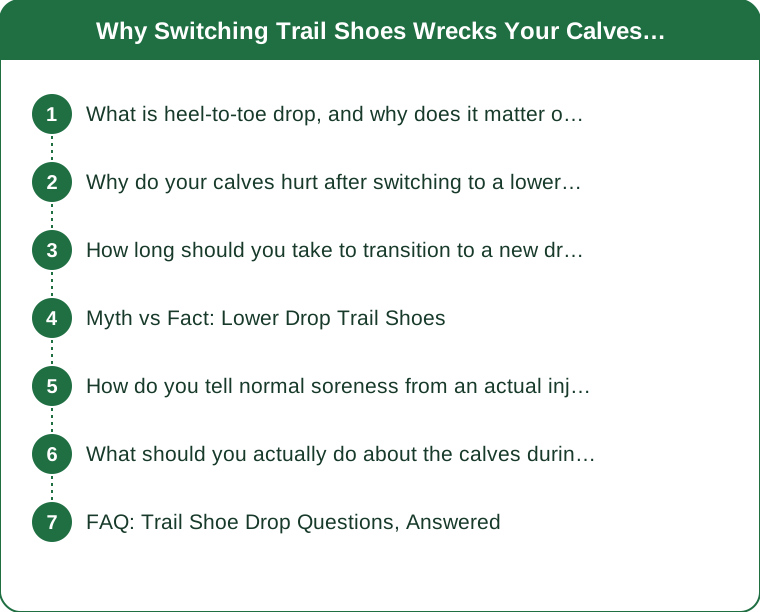
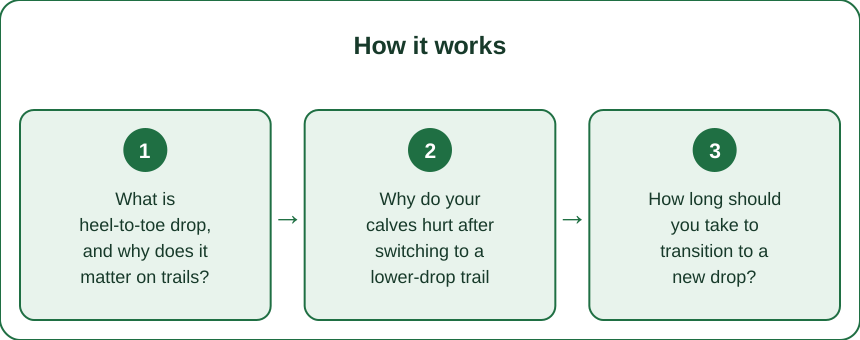
What is heel-to-toe drop, and why does it matter on trails?
Drop is the height difference between the heel and the forefoot of the shoe, measured in millimeters. A traditional trainer sits around 8-12mm. Most modern trail shoes land at 4-8mm, and minimalist models go to 0-4mm.
On roads, drop mostly changes how your ankle sits at touchdown. On trails, it does more. Uneven ground already forces your ankle through a bigger range of motion, and lowering the heel adds even more dorsiflexion at every awkward landing.
That combination is why the same 4mm change that feels like nothing on a bike path feels like a new sport on singletrack. The trail is amplifying the shoe.
Why do your calves hurt after switching to a lower-drop trail shoe?
A lower heel stretches your calf and Achilles a little further at every step. Multiply a few extra degrees by roughly 1,400 steps per mile and you have handed your calves thousands of extra reps of eccentric loading in a single run.
Eccentric work - the lengthening-under-load part - is exactly what produces delayed onset muscle soreness. That is why it usually peaks 24-48 hours after the run and not during it.
The uncomfortable truth is that this soreness is a normal adaptation signal. The tissue is being asked to do more. It gets stronger if you dose it and strained if you dump it all at once.
How long should you take to transition to a new drop?
Three weeks is a sensible floor for a change of 4mm or more. A ramp that has held up well in practice:
- Week 1: the new shoe on about 20% of weekly trail miles, easy terrain only, keep the old shoe for long runs
- Week 2: roughly 40-50%, add one runnable climb
- Week 3: 70%, including one technical descent
- Week 4: full switch if soreness has stopped returning
Add 15-20 minutes of new-shoe running per run rather than doubling. And keep the old pair alive - alternating shoes with different drops through the transition spreads the load instead of concentrating it.

Myth vs Fact: Lower Drop Trail Shoes
Myth: Lower drop means better running form. Fact: Drop changes ankle position, not hip mechanics. Cadence and posture do far more for form than millimeters under the heel.
Myth: If your calves hurt, you were running wrong before. Fact: You were running differently before. Your calves were doing less because the shoe was doing more.
Myth: You should push through the soreness so your body adapts faster. Fact: Adaptation happens between runs, not during them. Loading sore tissue repeatedly is the classic route to an Achilles problem.
Myth: Zero drop is the end goal for everyone. Fact: There is no evidence that a specific drop reduces injury across runners. The best drop is the one you can run on consistently without flare-ups.
How do you tell normal soreness from an actual injury?
Normal transition soreness is diffuse - it covers the belly of the calf, feels symmetrical, and eases as you warm up. It fades within 48-72 hours and gets smaller with each week of the ramp.
Warning signs point the other way. Pain that is pinpoint rather than spread out, pain in the tendon itself just above the heel, morning stiffness in the first steps out of bed, or soreness that is worse in week three than week one all mean stop adding volume.
A quick check: hop ten times on one leg. Normal soreness feels tired. A tendon problem feels sharp and makes you want to stop before ten.
This is general information, not medical advice. Persistent or sharp Achilles pain deserves a physical therapist or sports medicine visit before your next long run.
What should you actually do about the calves during the ramp?
Two exercises cover most of it. Straight-leg calf raises load the gastrocnemius: 3 sets of 12, slow 3-second lowering, off a step. Bent-knee calf raises with a 20-30 degree knee bend hit the soleus, the muscle that does most of the work on climbs: 3 sets of 12 the same way.
Do them twice a week on non-hard days, starting the week before you switch shoes if you can plan ahead.
Skip aggressive static stretching of a sore Achilles - it adds load to tissue that is already being asked for more. Easy walking, a warm shower, and another day are usually the better answer.
FAQ: Trail Shoe Drop Questions, Answered
Can I just switch back if my calves hurt?
Yes, and it is often the smart move mid-ramp. Going back to the old drop for a few runs does not undo your progress - it just spreads the adaptation over more days.
Does drop matter more going uphill or downhill?
Uphill loads the calves more because your heel rarely reaches the ground anyway. Downhill loads the quads and the Achilles differently, which is why a technical descent belongs late in the ramp, not early.
Do I need a lower drop for trails at all?
No. Plenty of strong trail runners stay at 8-10mm for years. Choose drop for how it feels over 90 minutes, not for what it signals.
TL;DR:
- Lower drop moves work from your knees to your calves and Achilles - the soreness is mechanical, not a sign you were doing it wrong.
- Ramp over at least three weeks: about 20% of trail volume week one, then add 15-20 minutes per run.
- Keep the old shoes in rotation through the transition instead of retiring them.
- Diffuse, symmetrical, fading soreness is normal. Pinpoint tendon pain and morning stiffness are not.
- Two calf raise variations twice a week do most of the protective work.
The shoe is not the problem and neither are your calves. The gap between them is a three-week project, and if you treat it like one, you get the shoe you wanted without the six weeks off you did not.
Keep Reading
This article is for general informational and styling purposes only. Fit, sizing, and product availability may vary.