Building Confidence on Technical Trail Terrain: A Step-by-Step Approach
Quick Answer: Confidence on technical terrain comes from slowing down deliberately on rocky or rooty sections, keeping your eyes 3-4 steps ahead rather than at your feet, and practicing on progressively harder terrain rather than avoiding it — avoidance is what keeps the fear alive.
Every trail runner remembers the trail that made them stop and question the whole sport. The fix isn’t toughness — it’s a specific set of habits that make technical footing feel manageable instead of random.

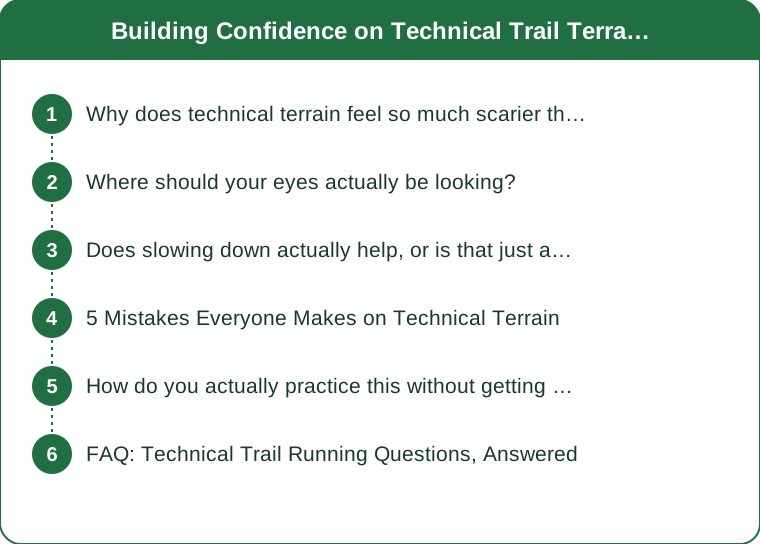
Why does technical terrain feel so much scarier than smooth trail?
Because your brain is processing unpredictable footing decisions in real time, and uncertainty reads as danger even when the actual fall risk is low. Road and smooth-trail running lets your brain go on autopilot; technical terrain demands constant micro-decisions, which feels exhausting and unsafe before it feels skillful.
Where should your eyes actually be looking?
3-4 steps ahead, not directly at your feet. Looking down at your immediate footing means you’re reacting to obstacles a half-second too late. Scanning ahead lets your brain pre-plan foot placement, which is what experienced technical runners are actually doing even when it looks instinctive.
Does slowing down actually help, or is that just avoiding the problem?
It genuinely helps — slowing down on technical sections isn’t giving up speed, it’s buying accuracy. Most falls happen when someone maintains smooth-trail pace on rocky ground. A shorter, quicker stride with a slight pace reduction through the technical section, then opening back up on the clear stretch after, is faster overall than pushing pace through it and stumbling.

5 Mistakes Everyone Makes on Technical Terrain
1. Staring at their feet instead of scanning ahead, which causes late reactions to obstacles.
2. Overstriding on uneven ground, reducing balance and reaction time between steps.
3. Tensing up through the shoulders and arms, which throws off natural balance — relaxed arms actually help you catch a stumble.
4. Avoiding technical trails entirely to sidestep the discomfort, which means the skill never develops.
5. Comparing their pace to smooth-trail pace, then feeling like a failure when technical sections are naturally 30-40% slower — that’s expected, not a performance problem.
How do you actually practice this without getting hurt?
Start with short, low-consequence technical sections — a rooty patch on a familiar trail, not a cliffside scramble. Walk it first if needed, then jog it, then run it at a controlled pace over multiple sessions.
Progressive exposure over 4-6 weeks on increasingly technical terrain builds real pattern recognition — your brain starts categorizing footing types faster, which is most of what ‘confidence’ actually is.
FAQ: Technical Trail Running Questions, Answered
Do trail running shoes actually make technical terrain easier?
Yes, meaningfully — a shoe with a rock plate and aggressive lug pattern gives real traction and protection feedback that boosts confidence, separate from any skill improvement.
Is it normal to walk technical sections even as an experienced runner?
Completely normal, and often faster than a shaky run through a genuinely difficult section — experienced trail runners walk far more technical terrain than beginners assume.
How long does it take to feel confident on technical trails?
Most people notice a real shift after 6-8 consistent sessions on varied terrain — confidence builds through repeated exposure, not through a single breakthrough run.
TL;DR:
- Look 3-4 steps ahead, not directly at your feet
- Slowing down through technical sections buys accuracy and is often faster overall
- Relaxed arms and a shorter stride beat tense, overstriding form on uneven ground
- Confidence builds through progressive exposure over 6-8 sessions, not avoidance
Keep Reading
This article is for general informational and styling purposes only. Fit, sizing, and product availability may vary.