Trail Running Vest vs Belt: Why Bouncing Hydration Gear Ruins Your Stride on Technical Terrain
Quick Answer: Hydration belts rely on a single point of contact around the waist, which works fine on flat, predictable road surfaces but bounces and shifts noticeably on technical terrain’s uneven footing and quick directional changes — a vest distributes weight across the shoulders and chest with multiple contact points, staying stable through exactly the kind of movement technical trails demand.
The belt felt secure on your road runs and even on smoother trail sections. Then the terrain gets technical — roots, rocks, quick direction changes — and suddenly the belt is bouncing against your hips, throwing off your footing exactly when precision matters most.

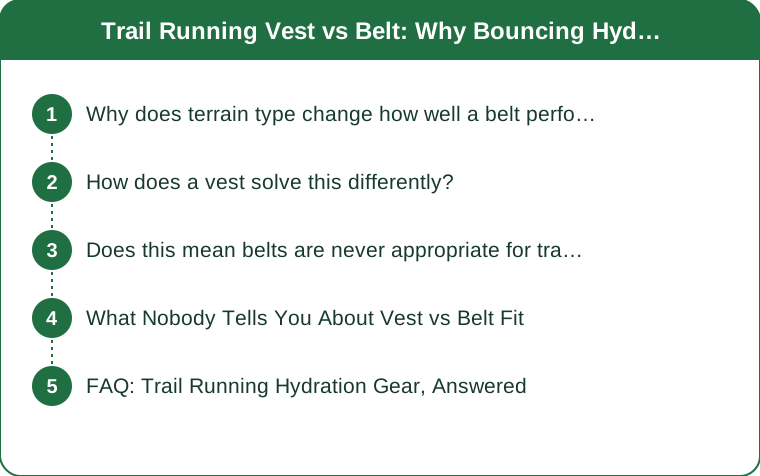
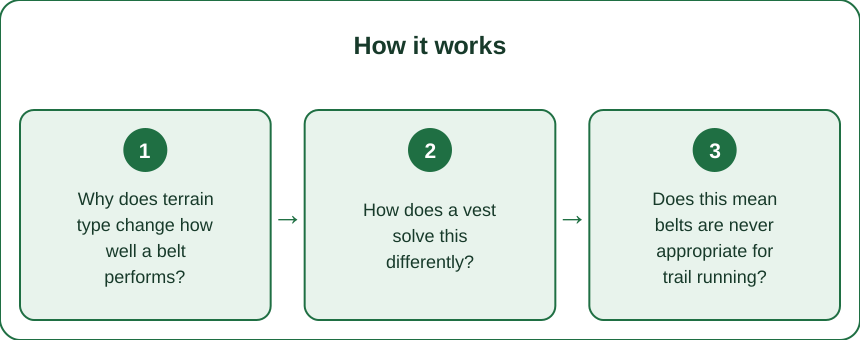
Why does terrain type change how well a belt performs?
A hydration belt is essentially a single band around your waist, held in place mostly by friction and a snug fit. On flat, predictable road surfaces, your body movement is relatively uniform, so the belt stays put with minimal bounce. Technical trail terrain introduces frequent, sudden vertical and lateral movement — stepping over roots, quick lateral dodges around rocks — that a single-point belt simply isn’t designed to stabilize against.
How does a vest solve this differently?
A running vest distributes weight across multiple contact points — shoulders, chest, and sometimes a light waist strap — which spreads out the forces from sudden movement rather than concentrating them at one band around the hips. This multi-point stability is specifically why vests are the standard choice for technical trail and ultra-running, where terrain unpredictability is the norm rather than the exception.

Does this mean belts are never appropriate for trail running?
Not at all — for smoother, less technical trails with predictable footing, a belt remains a lighter, often more breathable option than a vest, and many trail runners prefer belts specifically for those conditions. The choice comes down to matching gear to terrain, not one option being universally better.
What Nobody Tells You About Vest vs Belt Fit
A poorly fitted vest can bounce just as much as a poorly fitted belt — the multi-point stability advantage only holds if the vest is actually sized and adjusted correctly, with straps snug enough to prevent shifting but not so tight they restrict breathing or arm swing. Trying a vest loaded with your typical water and gear weight, then actually running (not just walking) in it, is the only reliable way to confirm the fit before committing to it on a real technical route.
FAQ: Trail Running Hydration Gear, Answered
Is a vest heavier than a belt overall?
Generally yes, somewhat, since it has more material and contact points — though the stability benefit on technical terrain often outweighs the small weight difference for many runners.
Can you combine a belt and a vest for different needs?
Some runners do use a minimal belt for short, easy trail sections and switch to a vest for longer or more technical routes, though most settle on one primary system for consistency.
Does hydration bladder placement in a vest affect stability further?
Yes — a bladder placed close to your back, centered between the shoulder blades, generally stays more stable than one that sits lower or off-center, which can reintroduce some of the bounce a vest is otherwise designed to prevent.
TL;DR:
- Belts rely on a single point of contact that works on flat, predictable terrain but bounces on technical trails
- Vests distribute weight across multiple contact points, staying stable through sudden directional changes
- Belts remain a valid, lighter choice for smoother, less technical trail sections
- A poorly fitted vest can still bounce — always test-run loaded before committing to it for a real route
The gear that felt fine on the road isn’t wrong — it’s just matched to a different kind of terrain than technical trail running actually demands.
Keep Reading
This article is for general informational and styling purposes only. Fit, sizing, and product availability may vary.