Trail Running vs Road Running: What's Different and How to Make the Switch
Quick Answer: Trail running is 1–3 minutes per mile slower than road running at the same effort, uses far more stabilizer muscles, and is measured by effort and time rather than pace. Road running is faster, more repetitive, and harder on the joints through repeated identical impact. To switch, forget your road pace entirely, start on smooth non-technical trails, and get shoes with real grip.
You run a comfortable 9:00 mile on the road. You go to a trail, run what feels like the same effort, and your watch says 12:30.
Nothing is wrong with you. You’re just doing a different sport now, and the sooner you accept that the sooner trails become fun instead of demoralizing.

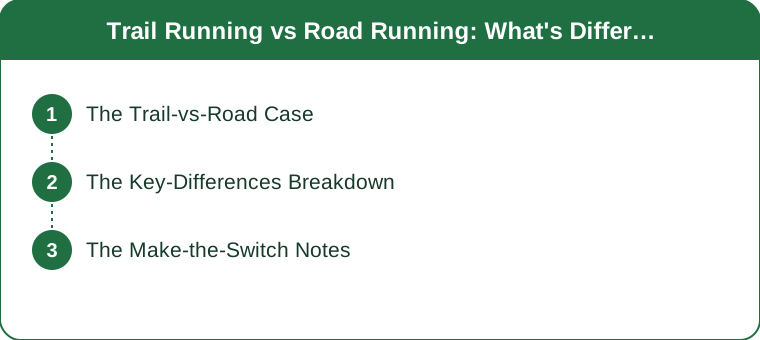
The Key Differences at a Glance
Terrain. Roads are flat, predictable, and identical every step. Trails have roots, rocks, mud, camber, and constant elevation change. Your foot lands differently every single stride, which is the source of nearly every other difference on this list.
Pace vs effort. On roads, pace is a meaningful measure of effort. On trails it’s noise — a runnable fire road and a technical climb produce wildly different numbers at identical effort. Trail runners measure in time and vertical gain, not pace.
Muscles used. Uneven ground recruits your ankle stabilizers, glute medius, and deep core continuously. Road running is a repetitive sagittal-plane motion; trail running is a full-body balance problem you happen to solve while moving forward.
Impact. Dirt is softer than asphalt, so peak impact per stride is lower. But it’s varied — you land on different surfaces at different angles, which spreads load rather than concentrating it. That’s why many runners with recurring road injuries do better on trails.
Technique. Trails require actively looking ahead, reacting, and — crucially — descending well. Downhill technique is a genuine skill that road running never asks you to develop.
Gear. Trail shoes with lugs for grip, and a vest for water once you’re past an hour. Road running needs neither.
Mindset. Roads are for zoning out with a podcast. Trails demand presence — you’re watching your feet, reading the terrain, making decisions. Most trail runners cite that forced attention as the main reason they switched.
Safety. Cell coverage, navigation, and telling someone your route all matter in a way they don’t on a neighborhood loop.

Myth vs Fact: Road Runner Moving to Trails
Myth: If I can run a road half marathon, a trail half will be similar. Fact: A hilly trail half can take 1.5–2x your road time. Elevation gain is the variable that matters, not distance.
Myth: Trail running is easier because it’s softer. Fact: Softer per impact, harder overall. Climbing, descending, and constant stabilization make it more demanding cardiovascularly and muscularly.
Myth: I need to run the whole thing. Fact: Power-hiking steep climbs is standard practice at every level, including elite. It’s a pacing strategy, not a failure.
Myth: My road shoes will be fine. Fact: On smooth fire road, yes. On anything wet, rooty, or steep, road shoes have no grip and it’s genuinely how people fall.
Myth: I’ll lose my road speed. Fact: Trail running builds strength, ankle stability, and aerobic base that transfer well. Many road runners get faster after adding trail work — you just need to keep some road running in the mix if racing on roads is the goal.
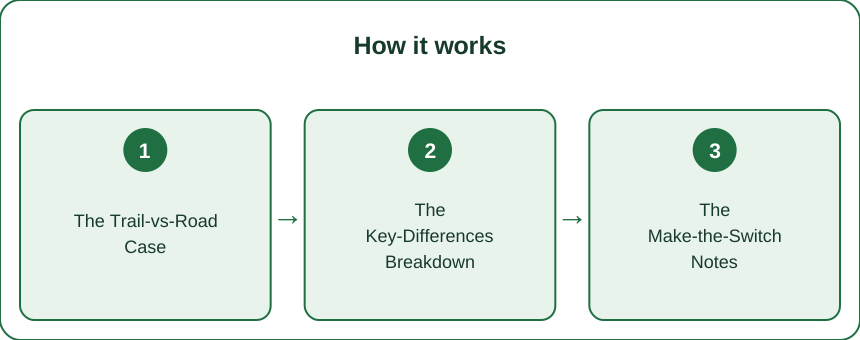
How to Make the Switch Well
1. Cover your watch, or at least stop looking at it. Your road pace is now irrelevant information that will only make you feel bad. Run by effort — the talk test still works fine.
2. Start on smooth, non-technical trails. Rail trails, fire roads, groomed park paths. Build the aerobic and stabilizer base before you add rocks and roots. Technical singletrack in week one is how ankles get rolled.
3. Learn to descend. This is where free time lives and where beginners are slowest. Quick, light feet; a slight forward lean from the ankles; eyes 10–15 feet ahead rather than at your shoes. Let gravity work and stop braking — braking is what wrecks your quads.
4. Get trail shoes. Lugs for grip, a rock plate if your trails are rocky. This is the one purchase that genuinely matters, and it matters most in wet conditions.
5. Build ankle and stabilizer strength. Single-leg balance work, calf raises, lateral band walks — 10 minutes, twice a week. Your ankles will be the limiting factor for the first month or two, not your lungs.
6. Handle safety like it’s a different activity, because it is. Tell someone your route and expected return, carry water past 45 minutes, download the map offline, and bring a phone. Solo runs in unfamiliar terrain deserve more caution than a neighborhood loop.
7. Adjust your expectations for a month. Everything will feel slower and harder for roughly 4–6 weeks while your stabilizers adapt. Then it clicks, and going back to a road loop feels weirdly flat.
FAQ
How much slower is trail running than road running?
Typically 1–3 minutes per mile slower at the same effort on moderate trails, and considerably more on steep or technical terrain. Elevation gain is the biggest factor — roughly 8–12 extra minutes per 1,000 feet of climbing for most runners.
Do I really need trail shoes to run trails?
On smooth fire roads and rail trails, road shoes are fine. On wet, rooty, rocky, or steep terrain, the difference in grip is substantial and it’s a genuine safety issue rather than a comfort preference.
Is trail running better for your knees than road running?
Often, yes. The softer, more varied surface spreads load across different tissues rather than delivering the identical impact thousands of times. The trade-off is a higher risk of acute injuries like rolled ankles, which is why starting on non-technical trails matters.
TL;DR:
- Trails run 1–3 min/mile slower at the same effort — measure time and vertical, not pace.
- Uneven ground recruits stabilizers constantly; expect 4–6 weeks of adaptation.
- Start on smooth non-technical trails and learn downhill technique early.
- Trail shoes are the one purchase that matters; grip is a safety issue.
- Add 10 minutes of ankle and single-leg work twice a week from day one.
Keep Reading
This article is for general informational and styling purposes only. Fit, sizing, and product availability may vary.