Why Your Ankle Rolls More in the Last Mile Than the First
Quick Answer: Rolling an ankle is not primarily a strength failure, it is a timing failure. The peroneal muscles on the outside of the lower leg have to fire within roughly 50 to 80 milliseconds of the foot inverting to prevent a roll, and that reaction time slows measurably as fatigue accumulates. Add reduced proprioceptive accuracy, a fatigued stride that lands flatter and closer to the ground, and fading light on a leaf-covered trail, and the last mile is where the odds change - not because you got weaker but because you got slower to react.
You ran the first four miles over the same roots without touching one.
Then the fifth mile happened and your ankle found a rock it had been ignoring all day.

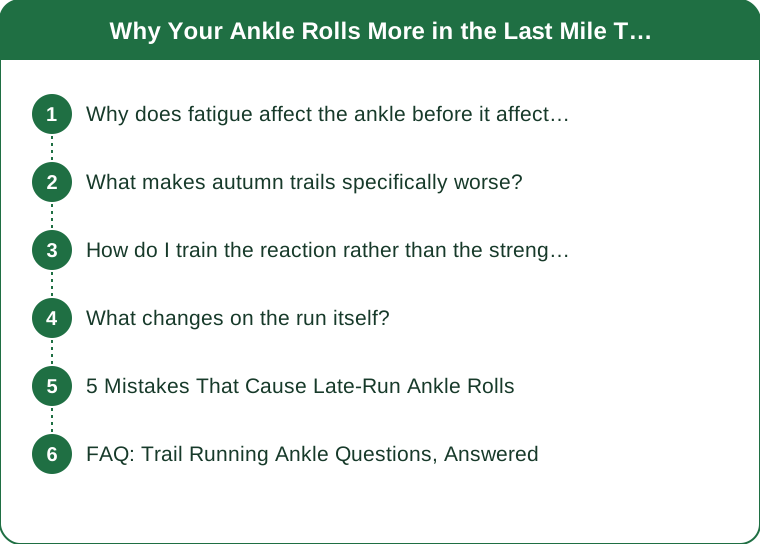
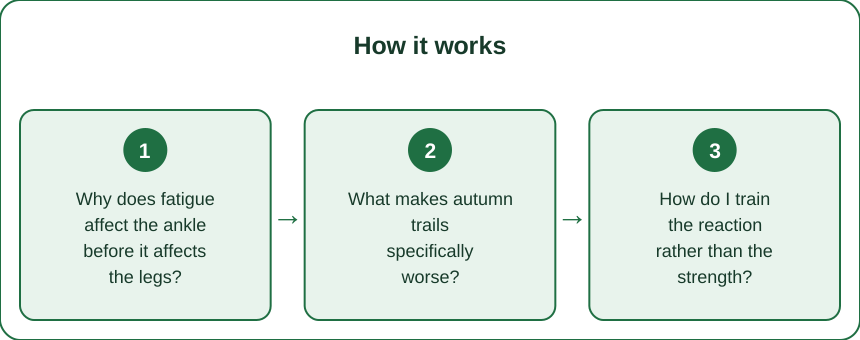
Why does fatigue affect the ankle before it affects the legs?
Preventing a roll is a reflex, not a decision. The peroneals have to contract within a few tens of milliseconds of the foot starting to invert, which is far faster than any conscious response.
Fatigue slows that latency. Studies on fatigued athletes consistently show delayed peroneal reaction time, and even a small delay is enough for the ankle to travel past the point the muscle can control.
Proprioception degrades in parallel. Joint position sense - your ability to know where your foot is without looking - measurably declines with fatigue, so the correction starts from worse information.
Your stride changes too. As you tire, foot clearance drops and you land flatter, which means less margin over obstacles and a less adaptable foot position on landing.
And you look further ahead less often, so your foot placement gets more reactive and less planned exactly when you need the opposite.
None of this is about how strong your calves are. It is about how quickly they can respond, and that is a separately trainable quality.
What makes autumn trails specifically worse?
Leaf cover removes the visual information your foot placement depends on. You are effectively running on a surface you cannot read, which puts the entire load on reaction rather than anticipation.
Wet leaves on rock or root are slippery in a way that dry leaves are not, and the slip usually happens on descents where speed is highest.
Light fades earlier and comes in at a low angle, producing long shadows across the trail that hide edges and misrepresent depth.
Cooler air means less warm-up before the pace picks up, and cold muscle has slower reaction times to begin with.
Autumn is also when people run longer, since the heat is gone, so fatigue accumulates further into the session than it did in July.
Which means the season stacks the two factors together - worse information and slower response - on the same runs.
How do I train the reaction rather than the strength?
Single-leg balance work is the foundation, and the eyes-closed version is where most of the benefit is, because it forces the system to rely on proprioception rather than vision.
Start with 3 sets of 30 seconds per leg, eyes closed, barefoot, and progress to a folded towel or cushion once that is easy.
Add perturbation. Balancing on one leg while catching and throwing a ball, or while someone lightly nudges you, trains the reflex specifically rather than the position.
Hop and stick landings - single-leg hops landing and holding for two seconds - train the rapid stabilisation that a bad step demands. 3 sets of 6 per leg.
Train it at the end of sessions, not the start, since the failure happens under fatigue and that is the state worth rehearsing.
And do lateral work, because ankles roll sideways and most running training is entirely sagittal - side steps, lateral bounds, and carioca all count.

What changes on the run itself?
Look four to six feet ahead rather than at your feet, which gives the planning system time to work and is the first thing to degrade when you tire.
Shorten your stride on descents and when tired. A shorter stride lands closer under the body, keeps foot clearance higher, and gives more time to correct.
Increase cadence rather than reach. More, quicker steps is a more stable pattern on technical ground than fewer, longer ones.
Ease off deliberately in the last portion of a long run, since the pace that is safe at mile two is not the same pace that is safe at mile eight.
Choose shoes with a lower stack for technical trails. More stack height means a longer lever and a higher platform to roll off, and there is a real trade-off against cushioning.
And eat and drink, because low fuel accelerates neuromuscular fatigue and that is precisely the system doing the catching.
5 Mistakes That Cause Late-Run Ankle Rolls
1. Treating balance work as rehab rather than training. Most runners only do single-leg balance after an injury. Done twice a week for ten minutes it is genuinely preventive, and it is the only training that directly targets the reflex that fails.
2. Running the same pace throughout. The trail does not get more dangerous, you get slower to respond. Planning to run the last third slightly slower is not a weakness, it is the correct response to a measurable change in your reaction time.
3. Wearing worn-out shoes on technical ground. A compressed midsole sits unevenly and a worn outsole loses grip on wet leaves. Ankle rolls cluster in shoes past their useful life, and the outsole tells you more than the mileage log.
4. Skipping the warm-up when it is cold. Cold muscle has slower contraction and slower reaction. In autumn, the first mile deserves to be genuinely easy, and a couple of minutes of ankle circles and lateral steps before starting is not optional once it is under 55F.
5. Running technical descents in fading light. This is the specific combination that produces most injuries - highest speed, worst information, most fatigue. If the light is going, take the descent slower or take the easier line, and accept the slower split.
And the bonus everyone gets wrong: taping or bracing every run. A brace is useful during a return from injury. Worn permanently on a healthy ankle it substitutes for the system you would rather be training, and the underlying reaction time never improves.
FAQ: Trail Running Ankle Questions, Answered
How long does a mild ankle sprain need before trail running again?
Most mild sprains tolerate flat easy running within one to two weeks, but technical trails need full pain-free single-leg balance and hop landings first, which usually takes longer than the pain does.
Do high-top trail shoes prevent rolls?
Evidence is mixed. Collar height offers limited protection against fast inversion and can create a false sense of security. Stack height and outsole grip matter more.
Is one ankle rolling more than the other normal?
Common, usually because of a previous sprain that never fully rehabilitated. Proprioception on a previously injured ankle stays impaired for a long time unless it is specifically retrained.
Does ankle mobility work help or hurt?
Dorsiflexion mobility helps, since a stiff ankle changes foot placement. Aggressive stretching into inversion does not, since laxity is not the goal.
Should I use trekking poles on trail runs?
On long technical descents and mountain routes, many runners do. On rolling trails they are usually more nuisance than benefit.
When should I see a professional?
If you cannot bear weight, if there is significant swelling or bruising, if the ankle feels unstable rather than sore, or if the same ankle keeps rolling despite training.
This is general information, not medical advice.
TL;DR:
- Ankle rolls are a reaction-time failure, and peroneal response slows measurably with fatigue.
- Proprioception degrades and stride clearance drops in the same window, so late miles carry the risk.
- Autumn stacks it: leaf-covered ground hides obstacles and low light hides edges.
- Train the reflex - eyes-closed single-leg balance, perturbation work, hop-and-stick landings, done at the end of sessions.
- On the run: look ahead, shorten stride, raise cadence, slow the last third, and replace worn outsoles.
You did not get weaker in mile five. You got slower to catch it.
Keep Reading
This article is for general informational and styling purposes only. Fit, sizing, and product availability may vary.