Why You Trip More at the End of a Trail Run and the Drills That Keep Toes Up
Quick Answer: Tired legs clear the ground by millimeters less — fatigued hip flexors and shin muscles let the swing foot droop, stride mechanics get sloppy, and attention drifts exactly when the light flattens late in a run. Since your foot only clears trail obstacles by a small margin at the best of times, that fatigue-driven drop is why trips and falls cluster in the final third. The counters are specific: dorsiflexor and hip-flexor strength, cadence nudged up five percent, a disciplined gaze three to five meters ahead, fueling before the fade, and the humility to walk the technical when cooked.
Here is what changes in a tired stride, the drills that raise it back, and the last-third protocol for your next long run.

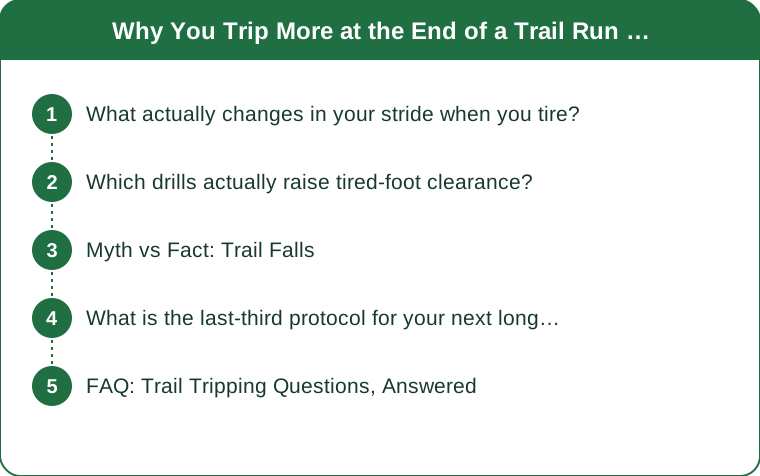
What actually changes in your stride when you tire?
Small numbers with big consequences.
Foot clearance is millimeters, always. Even fresh, a runner’s swing foot skims the ground with roughly an inch of margin over level trail — efficient, and unforgiving. Fatigue lowers that margin from three directions: hip flexors lift the thigh less, the shin’s dorsiflexors let the toes droop after repeated eccentric pounding, and stride length shortens into a shuffle that leaves less time and height for the swing. A few millimeters of droop meets a two-inch root, and the toe finds it.
Attention degrades on the same schedule. Early miles, you read the trail continuously; late miles, the mind wanders to the finish, the snack, the sore calf — and obstacle detection quietly hands off to luck. The classic trail fall is not on the gnarly rock garden, where you focus hard, but on the easy runnable stretch after it, where you stop looking.
Proprioception dulls as muscles fatigue, so the ankle’s corrections after a scuff arrive later and weaker — the same stumble you would have saved at mile two becomes a fall at mile nine.
And late summer adds a light problem. Evening runs that fit neatly inside July daylight now finish in long shadows or genuine dusk; flat, low light erases the shadow cues that make roots and rocks readable. The season’s trip spike is fatigue physiology plus a lighting change nobody adjusted for — worth naming, because both halves have fixes.
Which drills actually raise tired-foot clearance?
Train the lifters, sharpen the pattern, and rehearse it fatigued — twice a week, ten minutes.
Toe-up walks for the dorsiflexors. Walk twenty meters on your heels, toes pulled hard toward your shins, two or three passes. It looks ridiculous and it directly strengthens the muscles whose fatigue lets toes droop. Progress by adding a resistance band over the forefoot, anchored behind.
March-and-drive for the hip flexors. Exaggerated high-knee marches, ten per side, then A-skips — the classic drill where the knee punches up and the foot snaps down under you. Two rounds. These build the lift half of clearance and groove the knee-up pattern that survives fatigue.
Single-leg hops for stiffness and correction speed. Ten low hops per leg, landing quietly with the foot under you. This trains the ankle’s rapid-response stiffness — the save that turns a scuff into a stumble instead of a fall.
Cadence up five percent. Count your natural steps per minute on a flat stretch, then practice holding roughly five percent more with shorter steps. Quicker, shorter steps lower each stride’s flight and commit less to every foot placement, which shrinks both the trip chance and the cost of a bad step. On technical descents, cadence is the single most protective habit there is.
And rehearse while tired — carefully. End one run a week with five minutes of deliberate technical focus on easy terrain: tall posture, knees up, eyes scanning, cadence quick. The point is teaching the pattern to show up in the exact physiological state where trips happen. Skill practiced only fresh stays home when you are cooked.

Myth vs Fact: Trail Falls
Myth: Falls happen on the hardest sections. Fact: They cluster on easy and moderate ground late in runs — where speed is up, attention is down, and clearance has quietly dropped. The rock garden gets your respect; the smooth mile after it gets your ankles.
Myth: Stronger legs alone prevent tripping. Fact: General leg strength helps you resist fatigue, but clearance is a motor pattern plus specific small-muscle endurance — dorsiflexors and hip flexors. Squats do not train toes-up at mile nine; the drills do.
Myth: Watching your feet is the safest gaze. Fact: Staring at your feet means every obstacle arrives with zero planning time. The skilled pattern scans three to five meters ahead, letting the brain buffer the next several foot placements — glance down briefly for the truly technical, then eyes back up. Feet-watchers trip more, not less.
Myth: Poles prevent falls. Fact: Mixed. Poles aid climbing posture and give a fourth contact on sketchy descents, and they also occupy the hands that break a fall, snag on brush, and tempt runners into outsourcing balance. For most runnable terrain, trained clearance and cadence protect better than carbon.
Myth: Maximum lug shoes fix stumbling. Fact: Lugs fix traction — sliding, not tripping. Tripping is clearance and pattern; if anything, a heavier, higher-stack shoe slightly raises catch risk when the swing droops. Fit, proprioceptive feel, and a secure heel matter more to staying upright than tread depth.
What is the last-third protocol for your next long run?
Five habits that switch on when the fade begins.
Fuel before the fade, on a schedule. The clumsy-feet feeling tracks glycogen: falls and stumbles concentrate where the tank empties. Eating on time — every 40 to 45 minutes on runs past 90, starting early — keeps the brain sharp and the lifters supplied. If you have ever gone suddenly sloppy at mile ten, you have felt the fuel version of this problem.
Run the cadence check at every terrain change. Entering the last third, consciously quicken: shorter, quicker, quieter steps. Quiet is the audible test — loud slapping feet are low, late feet.
Re-post the gaze. Say it internally if needed: eyes up, three to five meters. Re-establish the scan every time you notice the mind at the finish line. In flattening evening light, add margin — slow slightly earlier than pride prefers, because the shadow cues you calibrated in July are gone by dinner now.
Walk the technical when cooked — as strategy, not surrender. Thirty walked seconds through late-run roots costs less than any fall ever has. The strongest trail runners are conspicuously unashamed walkers at the right moments; the ER math has never once favored the ego.
And dress for the season the run actually finishes in. Cooling evenings reward light gloves stashed in a pocket and high-waisted leggings with a phone pocket over shorts as dusk temperatures drop — a phone at the hip beats one in hand on technical ground, and covered legs shrug off the brush that overgrown late-season trails throw at every calf. A clip light or headlamp lives in the pack from now until spring; the day it saves your descent pays for the season.
Trips late in runs are not clumsiness — they are a trainable gap between fatigue and margin. Close it from both sides: raise the clearance, respect the fade.
FAQ: Trail Tripping Questions, Answered
Why do I always catch my toe on the same foot?
Asymmetry is normal — one hip flexor set is usually weaker or tighter, one ankle stiffer, and fatigue exposes the lesser side first. Bias the drills toward the catching side, and if one foot drags noticeably even fresh, or the asymmetry is new and worsening, have a clinician or PT take a look rather than training through it.
How long until the drills reduce stumbles?
Pattern changes — cadence, gaze — help on the very next run. Strength changes in the dorsiflexors and hip flexors show up in two to four weeks of twice-weekly work. Most runners report the late-run sloppy-feet feeling arriving noticeably later within a month.
Should I shorten my stride on all technical ground or just when tired?
Always on technical ground, and extra when tired. Shorter, quicker strides keep your center of mass over your feet, buy faster corrections, and lower each step’s commitment. It costs a little speed on paper and returns it in fewer broken rhythms — and dramatically fewer falls.
Are ankle weights good training for foot clearance?
Skip them for running — they distort the swing pattern and load joints oddly at speed. The march, skip, toe-up, and hop drills train the same muscles inside the real movement, and a resistance band over the forefoot progresses dorsiflexor strength far more safely than cuff weights ever will.
TL;DR:
- Foot clearance is millimeters even when fresh; tired hip flexors and shin muscles drop it further while attention and light fade — which is why trips cluster in a run’s final third.
- Train the lifters twice a week: toe-up walks, high-knee marches and A-skips, single-leg hops, plus a five-percent cadence bump and one fatigued-state technique rehearsal.
- Scan three to five meters ahead, fuel before the fade, quicken and quieten steps in the last third, and walk technical sections when cooked — strategy, not surrender.
- Late-season specifics: dusk arrives earlier than your July habits expect, so carry the light, add margin in flat evening light, and dress for the cooling finish.
Add the toe-up walks and the cadence check to this week’s runs. In a month, the roots at mile nine will still be there — and your foot will be three millimeters above them, which is all it ever needed.
Keep Reading
This article is for general informational and styling purposes only. Fit, sizing, and product availability may vary.