Why Your Downhill Pace Costs You More Than Your Uphill Pace Does
Quick Answer: Downhill running is eccentric loading — your quads lengthen under load with every step to brake your descent. Eccentric contractions cause far more muscle damage than concentric ones at the same effort, and the cost is delayed. That is why descents feel easy in the moment and expensive an hour later. Train descents specifically, or the climbs you paced perfectly will not matter.
Uphill: hard, and you feel it.
Downhill: easy, and you pay for it at 15km.
The bill just arrives late.

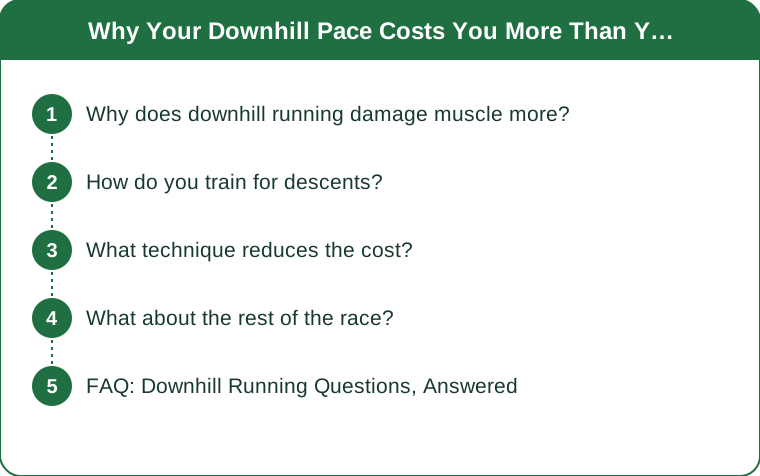
Why does downhill running damage muscle more?
Six mechanisms behind a cost that does not feel like one.
Eccentric contraction is the core of it. Going downhill, your quadriceps contract while lengthening, to control the descent. Eccentric contractions generate high force with relatively low metabolic cost — which is exactly why they feel easy and do more structural damage.
Force per step is higher. Impact forces running downhill can reach two to three times those of level running, depending on gradient and speed. Every one of those is absorbed by the same muscles.
Metabolic cost is low, so effort feels low. Your heart rate and breathing drop on a descent, which your brain reads as recovery. The muscular load is going the other way at the same moment, and there is no signal telling you.
Damage is delayed. Exercise-induced muscle damage typically peaks 24-48 hours later. During the run, the effect shows up as gradually deteriorating control rather than pain, which is why people misread it as fatigue rather than damage.
Stabiliser fatigue compounds it. Uneven trails demand constant ankle and hip stabilisation on top of the braking load. Those small muscles fatigue first, and when they do, your foot placement gets worse — which is when the ankle injuries happen.
And it accumulates across a race. Each descent leaves the muscles slightly less able to handle the next one. By the second half, the same descent produces more damage and worse control, which is why late-race descents are disproportionately where things go wrong.
How do you train for descents?
Six approaches, and the first is the one most runners skip entirely.
Run downhill deliberately in training. The specific adaptation to eccentric loading — the repeated bout effect — is real and substantial. A single hard downhill session provides meaningful protection against damage from subsequent ones for weeks. You cannot get this from uphill training.
Start conservatively and build. Downhill training causes real damage, so begin with short, moderate descents once a week and build gradually. Diving into long steep descents produces days of soreness and no useful adaptation.
Add eccentric strength work in the gym. Slow eccentric squats and split squats with a 3-4 second lowering phase, 3 sets of 6-8, twice weekly. This builds the same protective adaptation with less impact cost.
Train step-downs and single-leg control. Descending is a single-leg activity. Single-leg step-downs from a box, 3 sets of 10 per side, target exactly the control that fails late in a run.
Practise technique on the surface you will race on. Downhill running skill is highly surface-specific. Grass, rock and loose gravel each demand different foot placement, and confidence is trained, not innate.
Respect the recovery cost. A hard downhill session needs 48-72 hours before the next hard session. Treating it as an easy day because the heart rate was low is the classic error.
Seasonal note: autumn adds wet leaves and greasy rock to every descent, which shortens the steps you can safely take and increases braking load per step. Descents genuinely cost more in autumn than in summer, and a route you know well is not the same route in October.

What technique reduces the cost?
Six adjustments that reduce braking load rather than just tolerating it.
Increase your cadence and shorten your stride. Longer strides downhill mean landing further ahead of your centre of mass, which is a braking action absorbed entirely by your quads. Quick, short steps dramatically reduce peak force per step.
Lean slightly forward from the ankles, not backwards. The instinct on a steep descent is to lean back, which increases braking and puts you on your heels. A slight forward lean lets you run with rather than against the slope, and it feels wrong for about three sessions.
Land with the foot under your body. Foot placement ahead of the hips is the single biggest source of braking force. Under the body, every time.
Look ahead, not down. Scanning four to five metres ahead lets you plan foot placement, which produces smoother running and fewer emergency corrections. Looking at your feet means reacting late to everything.
Relax the upper body and use your arms. Tension increases impact transmission. Wide arms for balance, loose shoulders, and let the legs move underneath you.
Choose the line, do not just follow the path. Softer ground at the edge, a slightly longer but smoother line, or a series of small steps on a technical section all reduce total load. Experienced trail runners are constantly choosing lines rather than running down the middle.
What about the rest of the race?
Six things that determine whether the descent cost ruins your day.
Pace the early descents, not just the climbs. The most common trail racing error is bombing the first descent because it feels free. The bill arrives at 25km, and it is the reason so many trail races fall apart in the final third.
Fuel through the descents. They feel easy, so people stop eating and drinking. Keep taking fuel on the downhills — it is the easiest time to do it and your body is working harder than it feels.
Expect the delayed soreness. Peak muscle soreness at 24-48 hours after a hilly race is normal. Plan recovery around it rather than being surprised.
Recovery after downhill-heavy running takes longer. Muscle damage repair is slower than glycogen replacement. Allow more days than you would after a flat run of the same distance.
Kit that stays put matters here. Anything that shifts, rides up or bunches on a descent breaks your rhythm at exactly the point where foot placement matters most. A well-fitting waistband and shorts or leggings that do not ride are a performance factor on technical descents, not just a comfort one.
Watch your footwear tread. Grip on descent is the whole game, and worn lugs are the most common cause of falls. Check your outsoles regularly, especially heading into wet-season running. This is general information, not medical advice — persistent pain rather than normal soreness, particularly around the knee, deserves professional assessment.
FAQ: Downhill Running Questions, Answered
Why do downhills wreck my legs when they feel easy?
Downhill running is eccentric loading — high force, low metabolic cost. It feels easy and causes far more muscle damage, which shows up later.
How much higher are the impact forces?
Downhill running can produce impacts of two to three times level running, depending on gradient and speed.
Can I train to tolerate it?
Yes. The repeated bout effect means one hard downhill session provides real protection for weeks. Start with short, moderate descents once a week.
What strength work helps?
Slow eccentric squats and split squats with a 3-4 second lowering phase, 3x6-8, plus single-leg step-downs 3x10, twice a week.
What is the biggest technique fix?
Shorter, quicker steps with the foot landing under your body. Long strides downhill are pure braking.
Should I lean back on steep descents?
No — that increases braking and puts you on your heels. A slight forward lean from the ankles is correct, and it takes a few sessions to trust.
How long is recovery after a hilly run?
Longer than after a flat run of the same distance. Soreness peaks at 24-48 hours, and muscle repair is slower than refuelling.
TL;DR:
- Downhill running is eccentric loading — high force, low metabolic cost, so it feels easy and damages more.
- Impacts can reach two to three times level running, and the soreness peaks 24-48 hours later.
- Train descents deliberately — the repeated bout effect protects you for weeks, and nothing else provides it.
- Fix technique first: shorter quicker steps, foot under the body, slight forward lean, eyes 4-5m ahead.
- Add slow eccentric squats and single-leg step-downs twice a week, and allow longer recovery.
On your next trail run, count your steps on a descent and try to take twenty percent more of them over the same distance. That is the whole technique fix in one drill.
Keep Reading
This article is for general informational and styling purposes only. Fit, sizing, and product availability may vary.