Why Your Heart Rate Spikes on Trails at Paces That Feel Easy on Road
Quick Answer: Trail running recruits more muscle mass through constant stabilization, elevation change, and unpredictable footing, all of which raise heart rate at any given pace. Pace is a meaningless comparison between surfaces — train trails by effort or heart rate, never by road pace equivalents.
Your easy road pace is 9:30 and your heart rate sits at 140. On the trail you are running 11:45 and your watch says 168.
Nothing is wrong with your fitness. Your watch is measuring one thing and the trail is charging you for several others.

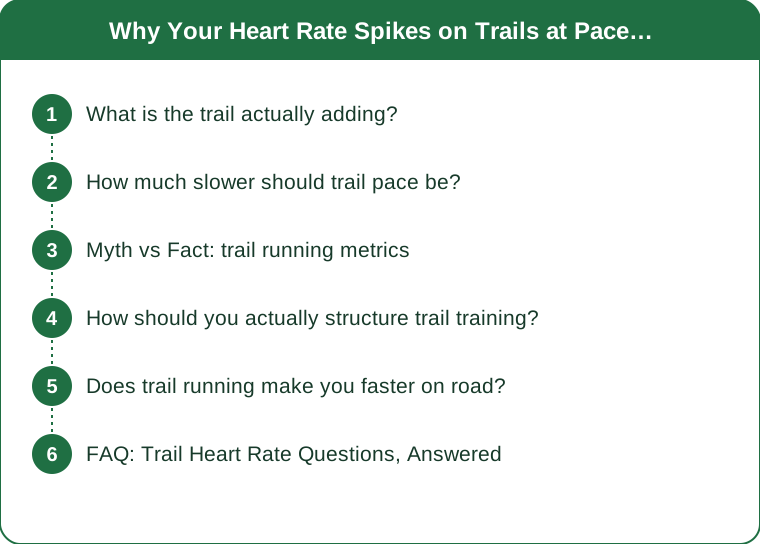
What is the trail actually adding?
Four distinct costs, none of which appear in a pace number.
Elevation. The obvious one. Running uphill at any pace dramatically increases cardiovascular demand — a 6 percent grade roughly doubles the metabolic cost of a given speed.
Stabilization. Uneven ground requires continuous work from ankle, hip, and trunk stabilizers. That muscle activity consumes oxygen and raises heart rate without producing forward motion. It is pure overhead.
Stride variability. On road, you repeat one efficient stride thousands of times, and your body optimizes for it. On trail, every stride is slightly different — different length, different landing angle, different push-off. You never enter the efficient groove.
Cognitive load. Scanning terrain and making constant foot placement decisions raises sympathetic activation. It is a smaller factor than the others, but it is real, and it is why technical descents can spike your heart rate while you are going downhill.
How much slower should trail pace be?
There is no fixed conversion, and chasing one is the main mistake.
As rough orientation, on smooth non-technical trail with modest elevation, expect 30 to 60 seconds per mile slower at equal effort. On moderately technical singletrack with rolling terrain, 1 to 2 minutes slower. On steep technical mountain trail, the comparison stops being meaningful — hiking the climbs is standard practice even for elite runners, and pace can be 3 to 5 minutes slower per mile.
The reason a fixed conversion fails is that trail difficulty varies enormously within a single run. The same runner on the same day may cover one mile in 8:30 and the next in 16:00, at identical effort.
Which is why trail runners increasingly ignore pace entirely and use heart rate, perceived effort, or power as the training variable. Vertical gain per hour is a more useful trail metric than minutes per mile.
Myth vs Fact: trail running metrics
Myth: If your trail pace is slow, your fitness is worse. Fact: Trail and road performance correlate but are not the same quality. Strong trail runners are often mediocre road racers and vice versa. Different demands, different skills.
Myth: Heart rate zones transfer directly from road to trail. Fact: Your zones themselves transfer — a heart rate is a heart rate — but the pace that produces each zone does not. Run trails by heart rate and ignore what pace results.
Myth: Walking the hills means you are not fit enough. Fact: Power hiking steep grades is faster and more economical than running them beyond a certain gradient, roughly 15 to 20 percent for most runners. Elite mountain runners hike. It is a technique, not a concession.
Myth: Downhills are recovery. Fact: Downhill running produces the highest eccentric loading of any running you do and causes the most muscle damage. Heart rate may drop; tissue cost goes up sharply.

How should you actually structure trail training?
Shift every reference point away from pace.
Run easy days by heart rate, strictly. Cap them at the top of zone 2 and accept whatever pace results, including walking. This is the hardest discipline for road runners moving to trail and the most valuable.
Measure hard efforts by time, not distance. A 20-minute tempo effort is repeatable across terrain; a 3-mile tempo is not.
Track vertical gain weekly. Feet of climbing per week is the trail equivalent of weekly mileage and a much better progression variable. Increase it by no more than about 10 percent per week.
Train descents deliberately. Because downhill causes the most damage, it needs progressive exposure. Start with 10 minutes of cumulative descent at effort and build. Runners who only train climbs get wrecked by race-day descents.
Build ankle and hip stability directly. Single-leg balance work, lateral band walks, and calf raises through full range. This reduces the stabilization overhead that is raising your heart rate in the first place, and it is the most direct route to a faster trail pace at the same effort.
Does trail running make you faster on road?
In several specific ways, yes — and it is worth knowing which, so you can use it deliberately.
Strength and stability improve substantially. The stabilization overhead that costs you on trail builds tissue that protects you on road, and many runners find chronic road injuries settle after adding trail volume.
Aerobic base builds efficiently. Because heart rate runs high at low speeds, trail running lets you accumulate aerobic stimulus at much lower impact than the equivalent road session. This is why many marathoners use trails for easy volume.
Running economy on varied terrain improves, which shows up on hilly road courses.
What trail running does not develop is leg turnover and sustained pace discipline. Trail runners returning to road often find their cadence has dropped and their ability to hold a precise pace has degraded. If you race on road, keep at least one weekly session on flat ground at goal pace.
The most useful arrangement for most runners is a mix: trails for easy and long volume, road or track for specific pace work. You get the durability without losing the speed.
FAQ: Trail Heart Rate Questions, Answered
Should I use a chest strap on trails?
Yes if you are training by heart rate. Wrist optical sensors are noticeably less accurate during the rapid changes and arm movement that trail running involves, and lag on climbs is common.
Why does my heart rate stay high on descents?
Eccentric loading is metabolically expensive, and technical descents add cognitive stress and upper-body bracing. A high heart rate on a descent is normal and does not mean you are running it too hard.
Is it worth using a running power meter for trails?
For many trail runners, yes — power responds to gradient in real time in a way pace cannot, making it a better moment-to-moment guide than either pace or lagging heart rate. It is an added expense, not a necessity.
How long before trail pace improves?
The stabilization overhead drops noticeably over 6 to 8 weeks of consistent trail exposure, and technical descending improves faster than that with deliberate practice. The pace change tends to arrive as a step rather than a slope.
TL;DR:
- Trails add elevation, stabilization work, stride variability, and cognitive load — none visible in pace.
- Expect 30 seconds to several minutes per mile slower at equal effort, depending entirely on terrain.
- Train by heart rate, time, and weekly vertical gain rather than pace or distance.
- Progress descents deliberately and train ankle and hip stability to reduce the overhead directly.
Your watch is telling you the truth about pace and nothing at all about effort. Switch the variable you train by, and the trail stops looking like a fitness regression and starts looking like the strength work it actually is.
Keep Reading
This article is for general informational and styling purposes only. Fit, sizing, and product availability may vary.