Why Your Late Summer Trail Pace Lies to You About Fitness
Quick Answer: In humid heat your heart rate runs higher and your pace runs slower at the same effort, because blood is diverted to the skin for cooling and plasma volume drops as you dehydrate. Meanwhile, late summer trails are dry and hard, which speeds up footing but changes impact loading. The result is data that looks like lost fitness and usually is not. Judge by effort in these conditions, and expect a large apparent improvement when the weather cools.
Your watch is measuring the weather as much as your legs.

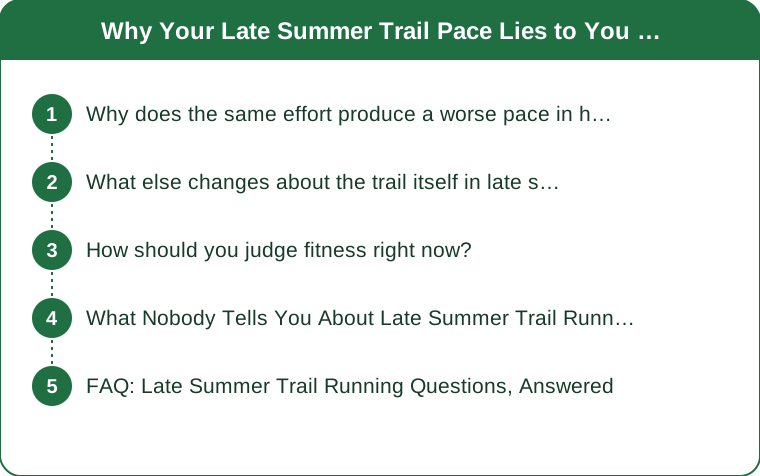
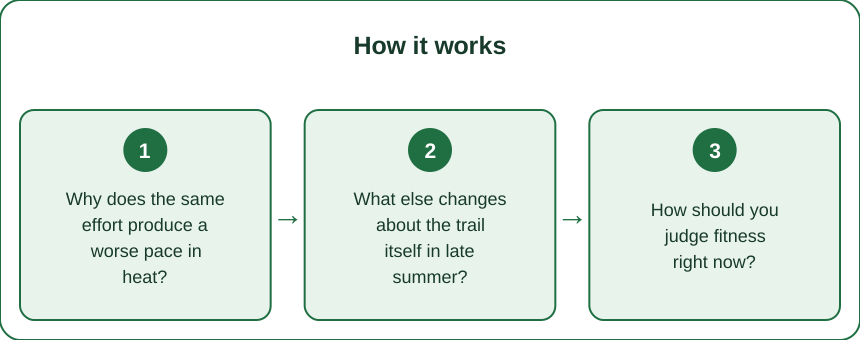
Why does the same effort produce a worse pace in heat?
Because a large share of your cardiac output is redirected to cooling instead of to your legs.
Working muscles need blood for oxygen delivery. So does your skin, for heat dissipation. In hot conditions those two demands compete, and the body prioritises thermoregulation.
Blood flow to the skin increases substantially in heat, which means less is available for muscle at a given cardiac output. The compensation is a higher heart rate at the same pace, which is what you see on your watch.
Then plasma volume falls. Sweating draws fluid from the blood, and as plasma volume drops, stroke volume falls, so heart rate rises further to maintain output. This is cardiovascular drift, and it is why heart rate climbs through a long run at constant pace.
Humidity makes all of it worse, because sweat that does not evaporate provides no cooling, so skin blood flow demand keeps rising while the fluid cost continues.
The practical numbers: in hot humid conditions, a runner can lose a meaningful percentage of their cool-weather pace at the same heart rate, and the effect grows with duration and with how unacclimatised you are.
On trails it compounds. Trail running already produces a heart rate response that is disconnected from pace, because terrain, gradient, and footing dominate. Add heat and pace becomes nearly meaningless as a fitness signal.
Acclimatisation offsets a substantial part of it. A well-acclimatised runner in late August is far less affected than the same runner in the first hot week of June, which is why mid-summer feels harder than late summer at the same temperature.
What else changes about the trail itself in late summer?
The surface, the footing, and what is hidden on it.
Trails are at their driest and hardest. Months without sustained rain compact the surface, and hard-packed dry ground returns more impact force to your legs than soft spring ground does.
Dust changes footing. A layer of fine dust over hardpack behaves like ball bearings, particularly on descents and on off-camber sections. Late summer is a common time for slips on trails that felt secure in spring.
Loose gravel and eroded surfaces accumulate over a season of use and dry weather, especially on popular descents.
Roots and rocks are more exposed as soil erodes and dries, and the ground around them is harder.
Vegetation is at maximum growth, which narrows trails, obscures the ground, and hides trail edges. Overgrown singletrack in late August is genuinely harder to run fast than the same trail in May.
Water sources are at their lowest, which matters for long runs, and a stream that ran in June may be dry now.
Wildlife and insects peak. Ticks remain active, biting insects are at their worst in humid conditions, and snakes are more active in warm weather in regions where that is a consideration.
And the light is changing fast. From the solstice to late August most of the country loses well over an hour of evening daylight, which is why evening runs that finished comfortably in July now finish in dusk. Carry a light for anything long in the evening.

How should you judge fitness right now?
By effort and by heart rate at effort, not by pace. And with a plan for what to compare against.
Use rate of perceived exertion as the primary guide. It integrates everything the watch cannot see — heat, humidity, terrain, fatigue, and how you slept.
Use heart rate as a secondary check, with the caveat that it drifts. Compare heart rate in the first 20 minutes rather than the average across a long run, since drift makes averages misleading in heat.
Compare like with like. A useful approach is to keep one repeatable benchmark — the same climb, run at the same effort, in similar conditions — and compare only against previous runs of the same benchmark in similar weather.
Do not compare summer trail paces to spring road paces. They measure different things.
Grade-adjusted pace helps and does not solve it. It accounts for gradient and not for heat, humidity, or surface.
Expect an apparent jump in autumn. When conditions cool, most runners see a substantial improvement in pace at the same heart rate within a couple of weeks, and almost all of it is the weather rather than sudden fitness gains. Enjoy it, and do not build a training plan on the assumption it will keep improving at that rate.
Train by time rather than distance in heat. A 60 minute run is a 60 minute run regardless of how far you go, and it removes the frustration of watching pace deteriorate.
Do the hard sessions when it is cool. Early morning, or accept that quality work in the middle of a humid day will be lower quality. There is no benefit to running intervals at heat-limited paces, since the intended stimulus does not happen.
What Nobody Tells You About Late Summer Trail Running
Your acclimatisation is at its peak right now and fades within two weeks. A late-season holiday in air conditioning undoes a summer of adaptation, and the first run back feels inexplicably terrible.
Downhill running in heat is more damaging than usual. Fatigued muscles absorb impact less well, and eccentric loading on hard dry ground is the classic recipe for delayed soreness. Late summer descents cost more than they used to earlier in the season.
Shoe grip depends on the surface, and dry dust is its own condition. Aggressive lugs designed for mud do relatively poorly on dry hardpack, where a flatter, stickier outsole grips better. Many runners are wearing the wrong shoe for the season without realising.
Sweat rate high plus dust equals eye and skin irritation, and salt residue plus dust is a real chafing accelerator on long runs.
Nutrition tolerance drops in heat. Blood diverted away from the gut means gels and solid food are absorbed more slowly and tolerated less well. Practise fuelling in cool conditions and expect it to be harder in the heat.
Evening runs are getting darker faster than people update for. Sunset is moving earlier by more than a minute a day in late August in much of the country.
This is the best time of year to build base. Heat limits intensity naturally, which pushes you toward easy aerobic running. Accepting that rather than fighting it produces a better autumn.
FAQ: Late Summer Trail Running Questions, Answered
Why is my heart rate higher at the same pace?
Blood is diverted to the skin for cooling, and plasma volume falls as you dehydrate, so your heart works harder to maintain the same output. Both effects grow through a run and with humidity.
Should I train by pace or by effort in summer?
By effort, and by time rather than distance. Pace in humid heat measures the weather as much as your fitness, and chasing it leads to running harder than the session intends.
Will my fitness actually improve when it cools?
Your measured performance will improve substantially, and much of that is the removal of heat stress rather than a new adaptation. The fitness you built through the heat is real and the size of the jump is mostly weather.
What shoe works best on dry late summer trails?
Something with a moderate lug and a grippy outsole compound. Deep aggressive lugs designed for mud are less effective on dry hardpack, where surface contact matters more than penetration.
TL;DR:
- Heat diverts blood to the skin and shrinks plasma volume, so heart rate rises and pace falls at the same effort.
- Late summer trails are dry, hard, dusty, and overgrown, which changes footing and impact loading too.
- Judge fitness by effort and early-run heart rate, train by time, and save hard sessions for cool mornings.
- Expect a large apparent improvement when the weather turns, and recognise it as weather rather than a new trajectory.
Run your next session by time and effort with the watch face covered. It is a more honest workout than the data suggests.
Keep Reading
This article is for general informational and styling purposes only. Fit, sizing, and product availability may vary.